
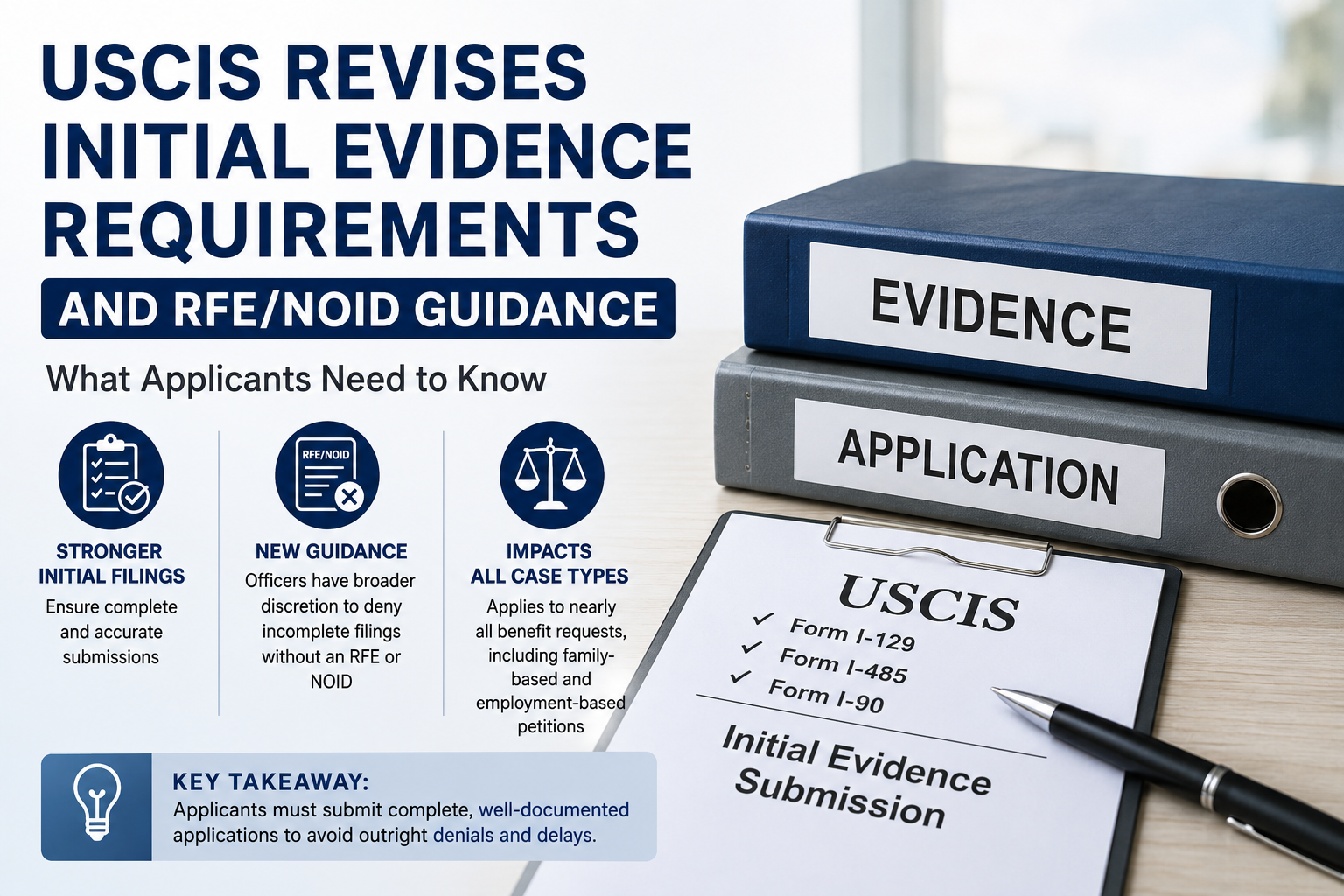
On August 5, 2026, USCIS issued Policy Alert PA-2026-05, changing how immigration officers look at initial evidence and decide whether to issue an RFE (Request for Evidence) or NOID (Notice of Intent to Deny).
In simple terms, this update gives USCIS officers more discretion when a filing is incomplete. Instead of always giving an applicant a chance to provide missing documents or fix an issue, an officer may now deny the application outright in certain situations without first sending an RFE or NOID.
This is important because the change applies to nearly all types of immigration benefit requests, including family-based petitions, employment-based cases, and adjustment of status applications that are filed or pending on or after August 5, 2026.
So, what does this mean for applicants? You really want to get your initial filing right the first time. Make sure you include all required forms, supporting documents, and evidence before submitting your application. A missing or incomplete piece of evidence could potentially put your case at greater risk than it was under the previous approach.
Bottom line: complete and well-organized evidence matters more than ever. Applicants should take the time to review their filing carefully before submitting it, rather than assuming USCIS will automatically give them a chance to correct missing information later.
What Did USCIS Revise About Initial Evidence Requirements?
USCIS updated Volume 1, Part E of the USCIS Policy Manual to give adjudicators full discretion to deny a benefit request without first issuing an RFE or NOID when required initial evidence is missing or the record does not establish eligibility.
Previously, USCIS guidance generally directed officers to issue an RFE or NOID before denying a case, even when a filing was substantially incomplete. That approach, adopted in 2021, treated the RFE and NOID process as something close to a built-in second chance. The August 2026 policy alert rescinds that instruction. USCIS says the earlier approach encouraged frivolous, placeholder, or substantially incomplete filings and contributed to longer processing times across the system.
The revised guidance does not eliminate RFEs and NOIDs. Officers still retain discretion to issue them when appropriate. What has changed is that officers are no longer instructed to default to an RFE or NOID simply because evidence is missing. If a benefit request lacks the required initial evidence, USCIS may now deny it directly.
The policy alert also updates related guidance on the evidentiary weight given to affidavits and shortens certain response timeframes, both discussed later in this article. It applies to benefit requests pending with USCIS or filed on or after August 5, 2026, unless a specific regulation or other policy provides otherwise. This is a significant procedural shift, and applicants preparing filings under any immigration category should factor it into how they prepare their evidence.
What Is “Initial Evidence” in a USCIS Application?
Initial evidence is the documentation an applicant or petitioner must submit with a benefit request at the time of filing to meet the requirements set out in the applicable form instructions, statute, or regulation.
Every USCIS form comes with instructions listing specific documents the agency expects to see from the outset — not after a follow-up request. Depending on the benefit sought, this might include identity documents, relationship evidence, financial documentation, employment records, or supporting affidavits.
The core legal principle behind initial evidence is that the burden of proof rests with the applicant or petitioner. USCIS does not have to build the case for eligibility; the requestor must establish it at filing and continue to meet that standard throughout adjudication. Where a specific document isn’t available, the filing should explain why and provide appropriate secondary evidence or affidavits instead of leaving the record silent.
Under the revised guidance, submitting complete initial evidence at filing is not just a best practice — it is the applicant’s primary opportunity to establish eligibility before USCIS decides whether an RFE, a NOID, or a denial is the appropriate next step.
What Is an RFE From USCIS?
A Request for Evidence, or RFE, is a formal notice from USCIS asking an applicant or petitioner to submit specific additional documentation because the record, as filed, does not fully establish eligibility for the requested benefit.
Why USCIS may issue an RFE. An officer may issue an RFE when the filing shows a genuine possibility that the applicant can overcome a gap in the record with additional evidence — for example, a missing certified translation or an outdated financial document.
What an RFE means. Receiving an RFE is not a denial. It means USCIS has identified specific unresolved questions and is allowing the applicant to address them, at the officer’s discretion.
What applicants should do after receiving one. Read the notice carefully, identify exactly what USCIS is asking for, and prepare a complete, organized response addressing every point raised.
Why the response deadline matters. Under the revised guidance, officers no longer default to the maximum response period; they may set a shorter, case-specific deadline. The response must be received by that date.
What can happen without a proper response. A partial response is treated as a request for a decision on the existing record, and a missed deadline typically results in denial based on the evidence already submitted.
What Is a NOID From USCIS?
A Notice of Intent to Deny, or NOID, is a formal warning that USCIS intends to deny a benefit request unless the applicant submits evidence or argument that overcomes the specific grounds identified in the notice.
How a NOID differs from an RFE. An RFE asks for missing pieces of the puzzle. A NOID signals that USCIS has already identified a likely basis for denial and is giving the requestor a final, narrower opportunity to respond before that decision is made.
When USCIS may issue a NOID. Officers may issue a NOID when the record raises a substantive eligibility concern — such as apparent ineligibility, inconsistent evidence, or indications of fraud or misrepresentation — rather than a simple documentation gap.
What a NOID means for an applicant. It reflects a more serious posture from USCIS than an RFE. The agency has, in effect, made a preliminary determination against the applicant.
Why the response should be carefully prepared. Because a NOID often addresses the merits of eligibility rather than a missing document, the response typically requires stronger legal and factual argument, not just additional paperwork. Many applicants involve an immigration attorney at this stage.
RFE vs. NOID: What Is the Difference?
| Factor | Request for Evidence (RFE) | Notice of Intent to Deny (NOID) |
| Meaning | A request for additional documentation to fill a gap in the record | A warning that the case is likely to be denied absent a successful response |
| Purpose | Complete an incomplete or unclear record | Give a final opportunity to overcome a specific denial basis |
| Typical Situation | Missing document, unclear evidence, or outdated information | Apparent ineligibility, credibility concerns, or significant inconsistencies |
| Applicant Response | Submit the specific requested evidence | Submit evidence and legal argument rebutting the stated grounds |
| Potential Outcome | Approval if the gap is resolved; denial if not | Approval if the concerns are overcome; denial if not |
How the Revised USCIS Guidance May Affect Applicants
The revised guidance applies broadly across immigration benefit categories, but its practical impact depends on how complete a filing is at the time of submission.
Family-based immigration. Petitioners and beneficiaries should ensure relationship evidence, identity documents, and required affidavits are complete at filing, since USCIS may now deny a petition outright rather than issue an RFE for missing documentation.
Employment-based immigration. Employers filing petitions should build in extra lead time to gather corporate evidence, wage documentation, and supporting materials before filing, since incomplete initial evidence carries a greater risk of direct denial rather than a follow-up request.
Adjustment of status. Applicants adjusting status should submit complete supporting evidence — including medical exams, financial support documentation, and identity records — at filing rather than assuming a deficiency will trigger an RFE.
Nonimmigrant petitions and applications. Petitioners filing nonimmigrant worker or visitor-related requests should treat form instructions and regulatory evidentiary requirements as mandatory at filing, not optional items to supplement later.
Other filings. USCIS guidance describes this shift as applying broadly to benefit requests generally. Applicants filing in other, more specialized categories should confirm how the update applies to their specific form by reviewing the applicable USCIS Policy Manual chapter or current form instructions, since this article does not cover every possible category individually.
What Evidence Should Applicants Submit With an Immigration Filing?
The specific evidence required varies by form and immigration category, so there is no single universal checklist. That said, several categories of documentation are commonly relevant across many filings:
- Required forms — the correct, current edition of the USCIS form, completed in full according to its instructions
- Identity documents — passports, birth certificates, or other government-issued identification
- Supporting records — documents specific to the benefit sought, such as court records or prior immigration history
- Financial evidence — where the benefit requires a showing of income, assets, or ability to support a beneficiary
- Relationship evidence — where the benefit depends on a qualifying family relationship
- Employment evidence — where the benefit depends on a job offer, employment history, or professional qualifications
- Translations — a complete English translation for any document in a foreign language, along with a certification of accuracy
- Certified documents — certified copies where the form instructions specifically require them
- Consistent information — names, dates, and facts that match across every form and supporting document in the filing
Because requirements differ by form, the applicable form instructions and the USCIS Policy Manual remain the authoritative source for what a specific filing needs.
Common Mistakes That Can Lead to Evidence Problems
Several recurring errors increase the risk of an RFE, NOID, or now, a direct denial:
- Missing required documents identified in the form instructions
- Incomplete forms, including unanswered questions or missing signatures
- Inconsistent information across forms, exhibits, or prior filings
- Unclear, low-quality, or illegible copies of documents
- Missing or incomplete certified translations
- Unsupported claims not backed by documentary evidence
- Failure to follow form-specific instructions and filing requirements
- Waiting until an RFE arrives to submit evidence that should have accompanied the original filing
Under the revised guidance, that last mistake carries more risk than before, since USCIS may deny the case before an RFE is ever issued.
What Should You Do If USCIS Sends an RFE?
- Read the entire notice. Understand exactly what USCIS is questioning and why.
- Identify exactly what USCIS requested. List each specific item requested, not just the general topic.
- Check the response deadline. Confirm the exact date, since deadlines may now be shorter and case-specific.
- Gather supporting evidence. Collect documents that directly address each requested item.
- Organize the response. Arrange evidence logically, with a cover letter or index if the response is lengthy.
- Address every USCIS request. Leaving any requested item unanswered risks a partial-record decision.
- Review the package. Check for consistency, completeness, and legibility before submission.
- Submit it according to USCIS instructions. Follow the specified filing method and mailing address exactly.
- Keep copies and proof of submission. Retain a full copy of the response and delivery confirmation.
What Should You Do If USCIS Sends a NOID?
A NOID requires a response that goes beyond simply supplying more paperwork. Because a NOID reflects USCIS’s preliminary conclusion that the case does not meet eligibility requirements, the response should directly rebut each ground stated in the notice with specific evidence and, where appropriate, legal argument addressing the relevant statute, regulation, or Policy Manual provision.
As with an RFE, the response deadline is controlling, and a partial or late response will likely result in a decision based on the existing record. Given the higher stakes involved, many applicants choose to consult an immigration attorney before responding to a NOID.
Does the Revised Guidance Make RFEs or NOIDs More Likely?
Based on the official policy alert, the change does not make RFEs or NOIDs themselves more likely — if anything, it makes officers more likely to deny an incomplete case directly rather than issue an RFE or NOID first. USCIS has not published data projecting future RFE or NOID volumes, so applicants should not assume a specific increase or decrease in either notice. What the guidance does make clear is that officers now have broader authority to skip the RFE or NOID step altogether when initial evidence is missing.
How Can Applicants Reduce the Risk of an RFE or NOID?
- Follow the current USCIS form instructions exactly, including the specific edition date
- Submit all required initial evidence at the time of filing, not afterward
- Organize documentation clearly, with translations and certifications attached where required
- Resolve inconsistencies across forms and supporting documents before submitting
- Verify that all foreign-language documents include complete, certified translations
- Keep full copies of everything submitted, along with proof of filing
- Consider professional legal advice for complex cases, prior denials, or unusual factual circumstances
Frequently Asked Questions
What changed in USCIS initial evidence requirements?
On August 5, 2026, USCIS revised its Policy Manual to give officers full discretion to deny a benefit request without first issuing an RFE or NOID when required initial evidence is missing or the record does not establish eligibility, reversing prior guidance that generally directed officers to issue an RFE or NOID first.
What is initial evidence for USCIS?
Initial evidence is the documentation required at the time of filing under the applicable form instructions, statute, or regulation to establish eligibility for the requested immigration benefit.
What is an RFE from USCIS?
A Request for Evidence is a notice asking an applicant to submit specific additional documentation because the filed record does not fully establish eligibility for the benefit sought.
What is a NOID from USCIS?
A Notice of Intent to Deny is a notice stating that USCIS intends to deny the case unless the applicant submits evidence or argument overcoming the specific grounds identified.
What is the difference between an RFE and a NOID?
An RFE typically addresses missing or unclear documentation, while a NOID signals a more serious, substantive concern about eligibility and represents a final opportunity to respond before denial.
How long do you have to respond to a USCIS RFE?
Under the revised guidance, USCIS officers set the response deadline case by case rather than defaulting to the maximum period previously used, so applicants should check the specific deadline stated on their notice.
Can USCIS deny an application without an RFE?
Yes. Under the August 2026 policy update, USCIS officers have full discretion to deny a benefit request without issuing an RFE or NOID when required initial evidence is missing or eligibility is not established.
How can I avoid an RFE from USCIS?
Submit complete, accurate, and well-organized initial evidence that follows the current form instructions exactly, including translations and required certifications, at the time of filing.
What happens if I do not respond to a USCIS RFE?
A missed deadline or an incomplete response is generally treated as a request for a decision based on the evidence already in the record, which often results in denial.
Should I hire an immigration attorney for an RFE or NOID?
Because RFEs can involve documentation gaps and NOIDs often involve substantive legal and factual disputes, many applicants – particularly those facing a NOID or a complex case – choose to consult an immigration attorney before responding.
Need Help With Your USCIS Filing, RFE, or NOID?
The revised USCIS guidance means there is far less room for error at the time of filing. If you’re preparing an application, responding to an RFE, or facing a NOID, the team at Orange Law can help you review your evidence, address USCIS’s specific concerns, and build the strongest possible response.
Contact Karan Joshi at Orange Law today for a case review.