
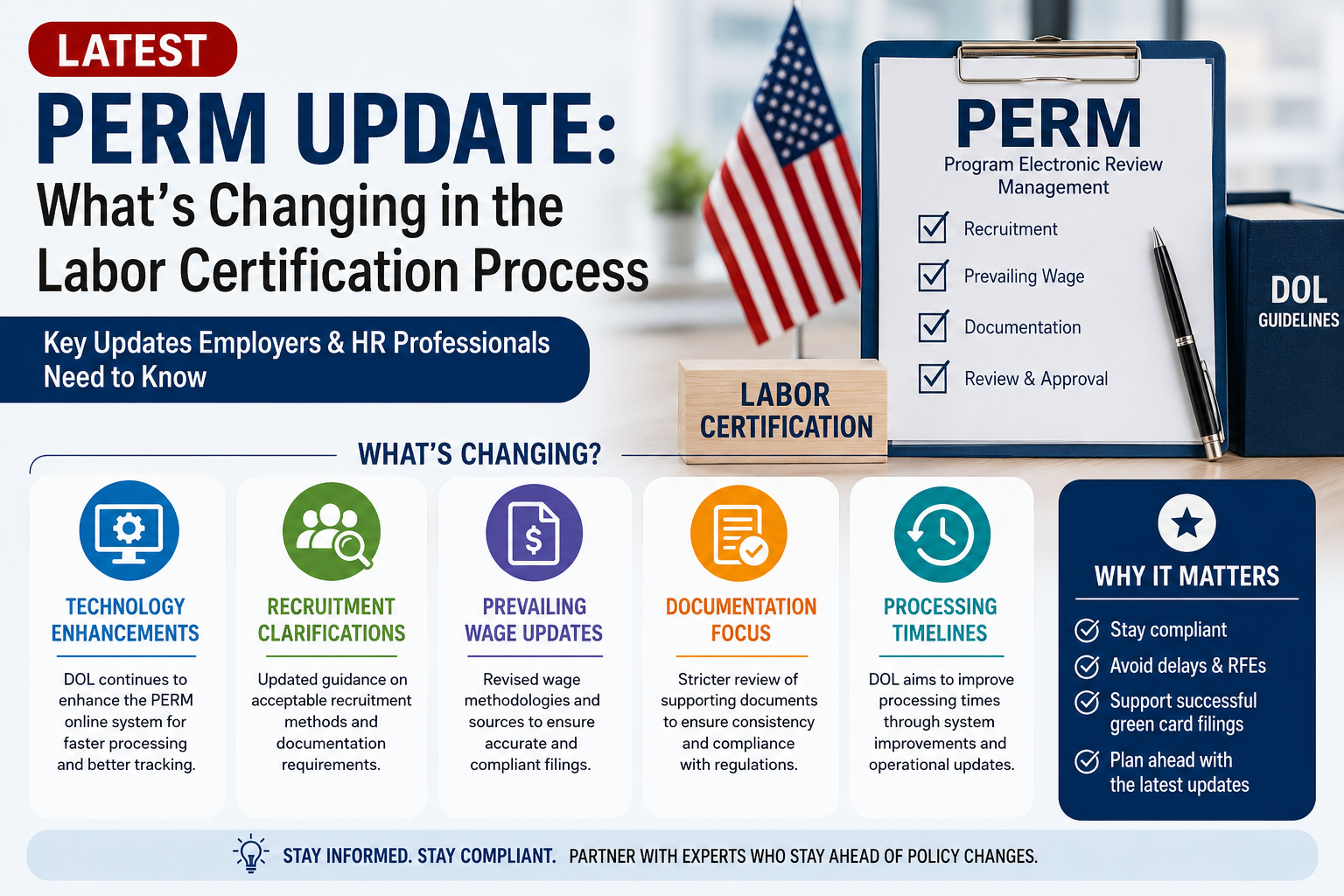
If you’ve been searching for a perm update because your green card case seems stuck-or you’re an employer trying to understand what’s actually changed at the Department of Labor (DOL)-you’re definitely not alone.
PERM has always been a slow process, but in 2026, there are two developments you really need to keep an eye on: a major regulatory proposal from the DOL and ongoing changes in PERM processing times.
Now, here’s the important part: these developments don’t change what you need to file today. However, they could have a real impact on how employers and foreign workers plan their PERM cases over the coming year.
At Orange Law, Attorney Karan Joshi and our team keep a close eye on these changes so our clients know what to expect and aren’t caught off guard. In this article, we’ll break down what’s actually changed, what’s still the same, and, most importantly, what you should do next.
What Is the Latest PERM Update?
The most significant recent PERM update came on July 3, 2026, when the U.S. Department of Labor (DOL), through its Spring 2026 Unified Agenda, announced plans to propose a new rule titled “Modernizing the Labor Market Test and Improving Protections for U.S. Workers in the PERM Immigrant Visa Program.”
Now, here’s the important part: this is only a proposed regulatory priority, not a final rule. In other words, the current PERM regulations are still in effect, and employers should continue following the existing requirements.
At the same time, PERM processing times have remained quite long in 2026, with many applications taking well over a year. The DOL publishes updated processing-time information each month through the FLAG system, so employers and applicants can keep an eye on where things currently stand.
Key PERM Updates You Should Know About
Here’s a closer look at the two developments actually driving the current conversation around PERM.
1. DOL Signals a Major PERM Modernization Effort
What changed: On July 3, 2026, the Department of Labor released its Spring 2026 Unified Agenda of Regulatory and Deregulatory Actions. In it, DOL listed a proposed rule (RIN 1205-AC25) aimed at overhauling the PERM labor market test – the recruitment and certification framework that hasn’t seen a substantial update in more than two decades.
When it changed: The regulatory priority was announced July 3, 2026. No proposed rule text has been published yet.
Who is affected: Any employer currently sponsoring, or planning to sponsor, a foreign worker through the EB-2 or EB-3 PERM process, and any foreign national whose green card timeline depends on PERM certification.
What it means for employers: DOL has stated the rule will likely touch recruitment procedures, employer compliance obligations, and recordkeeping standards. Nothing employers currently do is required to change yet – but this is a signal that current recruitment practices, which have stayed largely the same since the PERM regulations took effect, could look different once a formal rule is proposed and finalized.
What it means for foreign workers: If DOL’s stated objectives move forward, future PERM cases could face updated documentation standards or a different recruitment process altogether. Cases already filed or in progress under current rules should not be affected retroactively unless DOL specifies otherwise in a future rule.
What action, if any, should be taken: None immediately. This is a pending regulatory priority, not an active requirement. The responsible move is to keep filing under current PERM rules while staying informed as DOL moves – or doesn’t move – toward formal rulemaking.
2. PERM Processing Times Remain Extended
What changed: DOL continues to post monthly processing time updates for PERM (Form ETA-9089) and prevailing wage determination (Form ETA-9141) requests through the Foreign Labor Application Gateway (FLAG) system. Multiple monthly reports throughout 2026 have shown standard analyst review running well over a year from filing to decision, with figures fluctuating from one monthly update to the next depending on DOL’s workload and staffing.
When it changed: This is an ongoing trend rather than a single event – DOL has posted updated figures nearly every month in 2026.
Who is affected: Every employer and foreign worker with a pending PERM application, and anyone planning to file one.
What it means for employers: Recruitment and filing decisions should be made with the expectation that a decision may not arrive for well over a year. Filing early, and filing accurately, remains the best way to avoid adding avoidable delay on top of DOL’s existing backlog.
What it means for foreign workers: Nonimmigrant status planning (such as H-1B extensions) needs to account for extended PERM timelines. Workers should talk to their employer’s immigration counsel about how PERM delays interact with visa status limits.
What action, if any, should be taken: Check DOL’s current processing figures directly at flag.dol.gov before relying on any third-party estimate, since the numbers change monthly. Employers with cases well outside the posted processing window can contact the OFLC PERM Helpdesk for a status inquiry.
What Is PERM Labor Certification?
PERM (Program Electronic Review Management) is the process by which the Department of Labor certifies that:
- There are no able, willing, qualified, and available U.S. workers for a sponsored position, and
- Employing a foreign worker will not adversely affect the wages or working conditions of similarly employed U.S. workers.
Here’s how the pieces fit together:
- DOL oversees the entire PERM process through its Office of Foreign Labor Certification (OFLC).
- Prevailing wage determination (PWD) is obtained first, setting the minimum wage the employer must offer for the role.
- Recruitment follows, requiring the employer to test the U.S. labor market through specific advertising steps.
- ETA Form 9089 is the actual labor certification application, filed only after recruitment is complete.
- USCIS enters the picture after PERM certification, when the employer files Form I-140 to classify the worker for an employment-based green card.
PERM itself is not a visa and does not grant any immigration status. It’s the labor-market gatekeeping step that has to happen before most EB-2 and EB-3 green card sponsorships can move forward.
How the Latest PERM Update Affects Employers
Even though DOL’s proposed modernization rule isn’t in effect, employers should be thinking ahead on a few fronts:
- Prevailing wage accuracy: Errors in the PWD request (wrong SOC code, wrong worksite, wrong wage level) create downstream problems that can delay or jeopardize the entire case.
- Recruitment documentation: Every recruitment step – job postings, resumes received, interview notes, lawful reasons for rejecting U.S. applicants – needs to be preserved and organized in case of an audit.
- Recruitment timelines: Recruitment steps have specific minimum and maximum windows. Filing too early or too late relative to recruitment can result in a denial.
- Consistent job requirements: The job duties and requirements listed on the PWD, in recruitment ads, and on ETA Form 9089 must match. Inconsistencies are one of the most common triggers for audits.
- Recordkeeping obligations: Employers must retain PERM-related documentation for a set period after filing, regardless of whether DOL flags the case for review.
- Filing accuracy: Small errors on Form ETA-9089 – job titles, dates, employer information – can result in unnecessary denials that cost months to fix through refiling.
- Compliance risk awareness: With DOL signaling closer scrutiny of the PERM program in its regulatory agenda, employers should treat current compliance obligations as a floor, not a ceiling.
How the Latest PERM Update Affects Foreign Workers
For sponsored employees, the practical impact of any PERM update usually comes down to timing and stability:
- Sponsorship depends entirely on the employer. Foreign workers don’t file or control the PERM application – their employer and the employer’s counsel do.
- Recruitment and filing stages take time. Between PWD, recruitment, and DOL’s analyst review, the PERM stage alone regularly runs well over a year in 2026.
- Priority dates matter. The date the PERM application is filed becomes the worker’s priority date once the I-140 is later approved – a date that determines when a green card can actually be finalized based on visa bulletin availability.
- Delays can affect status planning. Workers on time-limited nonimmigrant visas need to coordinate PERM timing with their immigration attorney to avoid gaps in status.
- A pending regulatory change is not a current rule. Workers should not assume DOL’s modernization proposal changes anything about their pending or future PERM case until (and unless) a rule is actually finalized.
PERM Process: What Happens After Labor Certification?
PERM approval is a major milestone, but it is not the finish line. Here’s the sequence:
- PERM certification is granted by DOL.
- Form I-140 (Immigrant Petition for Alien Worker) is filed with USCIS, using the certified PERM as supporting evidence.
- Priority date and visa availability are checked against the Department of State’s Visa Bulletin, since green card numbers are limited by category and country of birth.
- Adjustment of status (if in the U.S.) or consular processing (if abroad) is the final stage, where the worker formally applies for permanent residence.
PERM Processing Time: Why It Keeps Changing
PERM processing time isn’t a fixed number — it moves based on:
- DOL’s current case volume and staffing at OFLC
- Whether a case is selected for audit review, which adds significant additional time
- Whether the PWD relies on standard OEWS wage data or a non-OEWS wage source, which are processed on separate timelines
- Broader government funding and operational status, which has occasionally affected DOL processing capacity
Throughout 2026, multiple monthly DOL updates have shown standard PERM analyst review running well over a year from filing to decision, with the exact figure shifting from month to month. Because these numbers change on a rolling basis, the only reliable source is DOL’s own FLAG processing times page, updated monthly.
PERM Stage Comparison Table
| PERM Stage | What Happens | Who Is Responsible | Why It Matters |
| Prevailing Wage Determination (ETA-9141) | DOL sets the minimum wage for the role | Employer (with counsel) | Sets the wage floor that recruitment and the job offer must meet |
| Recruitment | Employer advertises and documents efforts to hire U.S. workers | Employer | Required proof that no qualified U.S. worker was available |
| PERM Filing (ETA-9089) | Employer submits the labor certification application | Employer (with counsel) | Formal request for DOL certification |
| Analyst Review / Audit | DOL reviews (and may audit) the application | DOL / OFLC | Determines certification, denial, or further scrutiny |
| I-140 Petition | Immigrant petition filed with USCIS | Employer | Establishes the worker’s immigrant classification and priority date |
| Adjustment of Status / Consular Processing | Final green card application | Foreign worker | The last step toward lawful permanent residence |
Common PERM Mistakes to Avoid
- Inconsistent job requirements across the PWD, recruitment ads, and ETA-9089
- Incomplete recruitment documentation, including missing proof of ad placement or interview records
- Prevailing wage errors, such as an incorrect SOC code or wage level
- Recordkeeping gaps that surface only when an audit hits
- Inaccurate information on Form ETA-9089, from job titles to dates
- Timing mistakes, such as filing before recruitment requirements are fully satisfied
- Assuming old PERM practices always apply, without checking for the latest DOL guidance or processing rules
- Underestimating audit risk by treating recruitment as a formality rather than a documented, defensible process
When Should You Speak With a PERM Immigration Attorney?
Certain situations call for professional legal review rather than a DIY approach:
- Your job requirements are unusual, highly technical, or hard to justify against standard occupational codes
- You’re unsure whether your recruitment steps met DOL’s requirements
- Your prevailing wage determination seems inconsistent with the role
- You’ve received an audit notice or request for evidence
- You have questions about whether your case is even PERM-eligible
- You’ve had a prior PERM denial or withdrawal
- Your company has undergone a merger, acquisition, or restructuring that could affect the sponsoring employer
- You’re working against a tight visa status deadline
If any of these apply to your situation, Attorney Karan Joshi and the team at Orange Law can review your case specifics and help you understand your options going forward.
Why Work With Orange Law?
PERM cases involve a mix of DOL and USCIS requirements, strict documentation, and timelines that can change without much notice. At Orange Law, led by Attorney Karan Joshi, we help employers and foreign nationals navigate the PERM labor certification process and the broader employment-based green card journey-from developing a prevailing wage strategy and handling recruitment requirements to staying on top of compliance throughout the process.
The truth is, no one can guarantee an outcome or predict exactly how a case will move forward. What we can do is give you a clear, up-to-date picture of where your PERM case stands and what to expect next. We take the time to understand your situation, explain your options in plain English, and provide practical guidance based on the facts of your case.
Frequently Asked Questions
What is the latest PERM update?
The latest PERM update is DOL’s July 3, 2026 announcement, through its Spring 2026 Unified Agenda, of a proposed rule to modernize the PERM labor market test. It’s currently a stated regulatory priority, not a finalized rule, so no PERM requirements have actually changed yet. Employers should continue filing under existing regulations while monitoring DOL for further developments.
What is the current PERM labor certification process?
The current process requires employers to obtain a prevailing wage determination, complete a defined recruitment period, and then file Form ETA-9089 with DOL. DOL reviews the application, and may select it for audit, before issuing a certification or denial. This process has not changed under DOL’s proposed modernization rule, since that rule has not been finalized.
How long does PERM take in 2026?
PERM processing time has varied throughout 2026, with DOL’s monthly updates generally showing standard analyst review running well over a year from filing to decision, not including the PWD and recruitment stages beforehand. Because DOL posts updated figures monthly on the FLAG system, the most accurate current number should always be checked directly at flag.dol.gov rather than relying on a fixed estimate.
Has the PERM process changed recently?
The underlying PERM process and regulations have not formally changed. What’s new is DOL’s stated intent, announced in July 2026, to pursue a significant regulatory overhaul of PERM’s labor market test. Until a proposed rule is published and finalized through notice-and-comment rulemaking, current PERM procedures remain the applicable standard.
What happens after PERM is approved?
Once PERM is certified, the employer files Form I-140 with USCIS to petition for the worker’s immigrant classification. From there, the worker’s priority date and visa category availability determine when they can move to adjustment of status or consular processing. PERM certification does not guarantee I-140 approval or an eventual green card.
Can a PERM application be audited?
Yes. DOL can select any PERM application for audit review, which typically requires the employer to submit supporting documentation for recruitment, wage determination, and job requirements. Audited cases generally take significantly longer to resolve than standard, non-audited applications, and inconsistent or incomplete records are common audit triggers.
What happens if DOL denies a PERM application?
A denied PERM application can sometimes be addressed through a motion for reconsideration to the certifying officer, or by refiling a corrected application, depending on the reason for denial. Some denials stem from fixable documentation or filing errors, while others reflect more fundamental eligibility issues. An attorney can review the denial notice to identify the best path forward.
When should I speak with a PERM immigration attorney?
You should speak with a PERM immigration attorney if you’ve received an audit notice, face unusual job requirement or wage issues, have had a prior denial, or are working against a tight visa status timeline. Getting experienced legal guidance before problems compound, rather than after a denial, generally gives you more options for how to proceed.
Have a PERM Question That’s Specific to Your Case?
General information can only get you so far-especially when a PERM update may be on the horizon and processing times are still taking longer than expected. If you’re dealing with a PERM delay, an audit notice, a recruitment issue, or you’re just not sure what your next step should be in the employment-based green card process, Attorney Karan Joshi and the team at Orange Law are here to help. They can take a closer look at your specific situation, explain what’s going on, and help you understand where you actually stand.