
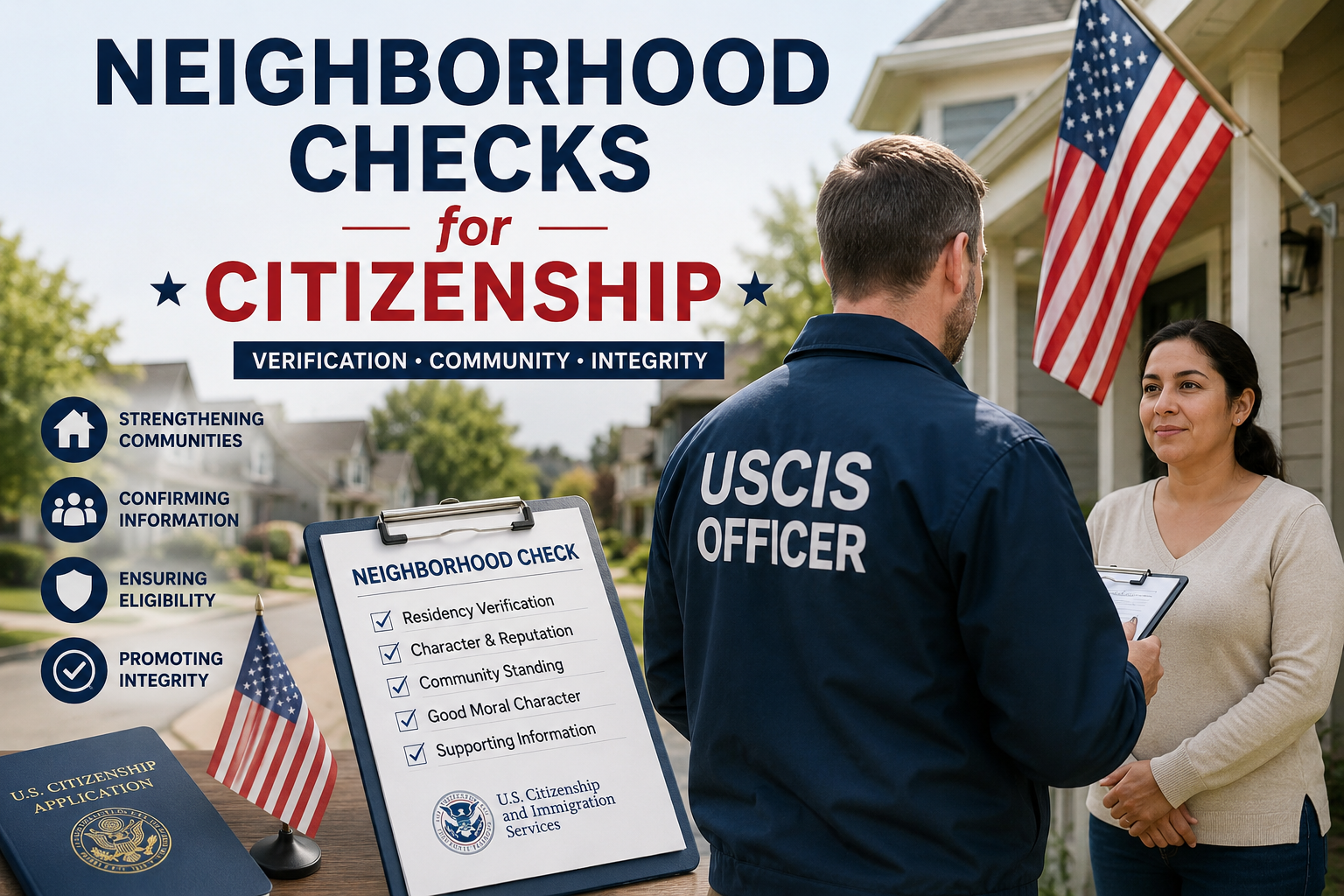
If you’re getting ready for naturalization, you may have come across the term “neighborhood checks for citizenship” in online forums or heard other applicants talking about it. Basically, USCIS does not routinely send officers door-to-door to interview your neighbors as part of the standard naturalization process.
What USCIS does conduct are formal background and security checks connected to your Form N-400. In some cases, USCIS may also look into additional information if something in your application needs clarification or raises a question.
And honestly, this distinction is important. A lot of applicants search for “neighborhood checks for citizenship” because they’re understandably worried about what USCIS may know, what an officer might ask, or whether someone in their neighborhood could be contacted about them.
So, let’s clear things up. This guide explains what actually happens, what is often misunderstood, and what you can do to prepare for the different stages of the naturalization background review.
What Are Neighborhood Checks for Citizenship?
The phrase “neighborhood checks for citizenship” is not official USCIS terminology. It’s a term applicants use informally to describe the idea that USCIS might verify information about them by speaking with people who know them – neighbors, landlords, or community members.
In practice, applicants usually mean one of a few different things when they use this phrase:
- The general naturalization background check process (fingerprints, FBI records, security screening)
- USCIS’s authority to conduct additional investigation when a case raises questions
- Older historical practices associated with certain immigration benefit investigations, which some applicants have heard about anecdotally
It’s important to separate this informal phrase from the official USCIS background and security checks required for every N-400 applicant, which are well-documented and consistent. Those formal checks are described in detail below.
Does USCIS Really Check Your Neighborhood?
No – not as a standard, routine step for every applicant. There is no published USCIS policy requiring officers to interview neighbors for every naturalization case.
That said, USCIS retains broad authority to verify the information in your application. If your case includes unresolved questions, inconsistent statements, or issues related to good moral character, USCIS may conduct additional investigation. The exact scope of that investigation depends on the specific case and is determined by USCIS, not by a fixed, publicized checklist.
The key takeaway: applicants should not assume that filing Form N-400 automatically triggers a neighborhood investigation. For the vast majority of cases, verification happens through document review, biometrics, and the naturalization interview – not field visits to your community.
What Background Checks Are Required for U.S. Citizenship?
Every N-400 applicant goes through a standard citizenship background check process. This is where most of USCIS’s verification actually happens.
- Biometrics and fingerprints. Most applicants attend a biometrics appointment where USCIS collects fingerprints, a photo, and a signature.
- FBI background check. Your fingerprints are run against FBI criminal history databases as part of the naturalization background check.
- Identity verification. USCIS confirms that you are the person who filed the application and that your identity documents are consistent.
- Immigration history review. USCIS reviews your immigration record, including entries, exits, and any prior applications.
- Criminal history review. Any arrests, charges, or convictions are checked against your N-400 disclosures.
- National security and law enforcement screening. USCIS checks applicants against relevant security databases, a process required for all naturalization applicants regardless of background.
- Review of your N-400 submission. USCIS Adjudicators compare your written answers, supporting documents, and interview responses for consistency.
These formal steps make up the real substance of the naturalization background check – and they apply to essentially every applicant, not just those with complicated histories.
Why Might USCIS Ask Additional Questions About an Applicant?
Sometimes an officer asks follow-up questions beyond the standard interview script. This does not necessarily signal a problem – but it’s worth understanding what can prompt it:
- Inconsistent information between the N-400 and supporting documents
- Gaps or discrepancies in your address or residence history
- Prior criminal or immigration history that needs clarification
- Missing or unclear documentation
- Statements made during the interview that need follow-up
- Apparent discrepancies between your written application and your testimony
An additional inquiry is not an automatic denial. It’s often simply USCIS’s way of resolving a question before making a decision.
What Happens During a Citizenship Background Investigation?
The naturalization process generally follows this sequence:
- File Form N-400. This starts the naturalization process and your case record with USCIS.
- Biometrics and background screening. Most applicants attend an appointment for fingerprints and identity verification.
- USCIS case review. Your background check results and application are reviewed internally.
- Naturalization interview. You’ll be asked about your application, complete the English and civics tests, and answer follow-up questions.
- Additional investigation or evidence, if needed. USCIS may request more documentation or clarification before deciding.
- Decision. USCIS approves, denies, or continues the case pending further review.
Each stage builds on the last, and most applicants move through the process without any unusual delays or extra investigation.
Can USCIS Talk to Your Neighbors About You?
This is often the exact question behind searches for “neighborhood checks for citizenship.” The honest answer: applicants should not assume this happens in a typical case.
USCIS has legal authority to verify information relevant to an application, and the specific tools it uses can vary by case. However, there is no indication that interviewing neighbors is a routine, standardized step for ordinary naturalization applications. If any additional verification beyond the standard background check occurs, the method depends on the specific facts of the case – not a universal procedure applied to everyone.
If you’re concerned about a specific aspect of your case, an immigration attorney can help you understand what verification might reasonably apply to your circumstances.
What Can Cause Problems During a Citizenship Background Check?
Certain issues are more likely to raise questions or slow down a naturalization background check:
- Undisclosed arrests or criminal history
- Incorrect or incomplete information on Form N-400
- A long or complicated residence or travel history
- Prior immigration violations
- Inconsistent answers between the application and the interview
- False claims of U.S. citizenship made in the past
- Tax-related concerns, where legally relevant to eligibility
- Questions related to good moral character
- Missing supporting documentation
None of these automatically disqualify an applicant, but they often benefit from careful preparation and, in more complex situations, professional legal review.
How Should You Prepare for Citizenship Checks?
Good preparation can reduce stress and prevent avoidable delays:
- Review your N-400 before the interview so your answers stay consistent.
- Keep your address and employment history accurate and complete.
- Gather supporting documents in advance rather than scrambling before the interview.
- Be truthful and consistent across every part of your application.
- Disclose relevant issues when required, rather than omitting them.
- Review your immigration and criminal history so nothing catches you off guard.
- Seek legal advice if your case involves any complexity.
When Should You Talk to an Immigration Lawyer?
Most naturalization applicants move through the process without needing legal representation. But certain situations benefit significantly from professional guidance, including:
- Prior arrests or criminal convictions
- Past immigration violations
- Inconsistent information across prior filings
- A previously denied application
- Extended periods of time outside the United States
- Questions about good moral character
- A complicated N-400 or immigration history
- A Request for Evidence (RFE) or additional notice from USCIS
- Concerns about possible discrepancies in your record
If any of these apply to you, working with a citizenship lawyer or naturalization lawyer before filing – or before your interview – can help you understand your situation more clearly and prepare accordingly. Orange Law works with applicants navigating these more complex circumstances as part of the broader naturalization process.
How Orange Law Can Help With Citizenship and Naturalization
Orange Law assists eligible applicants in understanding their options throughout the naturalization process, including:
- Reviewing your eligibility for citizenship
- Reviewing your completed or draft Form N-400
- Identifying potential issues before they become problems at the interview
- Preparing for the citizenship interview
- Helping you understand USCIS requests or notices
- Providing case-specific guidance based on your immigration history
If you are concerned about background checks, possible additional inquiries, or an issue in your naturalization history, Orange Law can help you understand your options and prepare for the next step.
Related reading: U.S. citizenship lawyer | citizenship application | immigration attorney | citizenship interview preparation
Frequently Asked Questions About Neighborhood Checks for Citizenship
What are neighborhood checks for citizenship?
Neighborhood checks for citizenship” is an informal term applicants use to describe the idea that USCIS might verify their background through community sources. It is not official USCIS terminology, and it should be distinguished from the formal background and security checks required of every N-400 applicant.
Does USCIS visit neighbors during the citizenship process?
Not as a routine, standard step. There is no published policy requiring officers to interview neighbors in ordinary naturalization cases. USCIS does retain authority to conduct additional investigation when a case raises specific questions.
Does every citizenship applicant undergo a neighborhood check?
No. Every applicant undergoes the standard naturalization background check (biometrics, FBI records review, identity and security screening), but there is no indication that routine neighbor interviews apply to typical applicants.
What background checks are done for naturalization?
USCIS conducts biometrics collection, an FBI criminal history check, identity verification, immigration history review, and national security screening as part of every N-400 case.
Can a criminal record affect a citizenship application?
Yes, criminal history can affect eligibility and may require additional documentation or legal review, depending on the nature and timing of the offense.
What happens if USCIS needs more information after the interview?
USCIS may issue a Request for Evidence or schedule a follow-up appointment. This does not necessarily mean denial – it typically means USCIS needs clarification before deciding.
Should I hire an immigration lawyer for my citizenship application?
It depends on your circumstances. Straightforward cases often don’t require one, but complicated immigration or criminal history, prior denials, or inconsistencies are strong reasons to consult a citizenship lawyer.
How can Orange Law help with a naturalization case?
Orange Law can review your eligibility, help prepare your N-400, identify potential issues in advance, and guide you through interview preparation and any USCIS follow-up requests.