
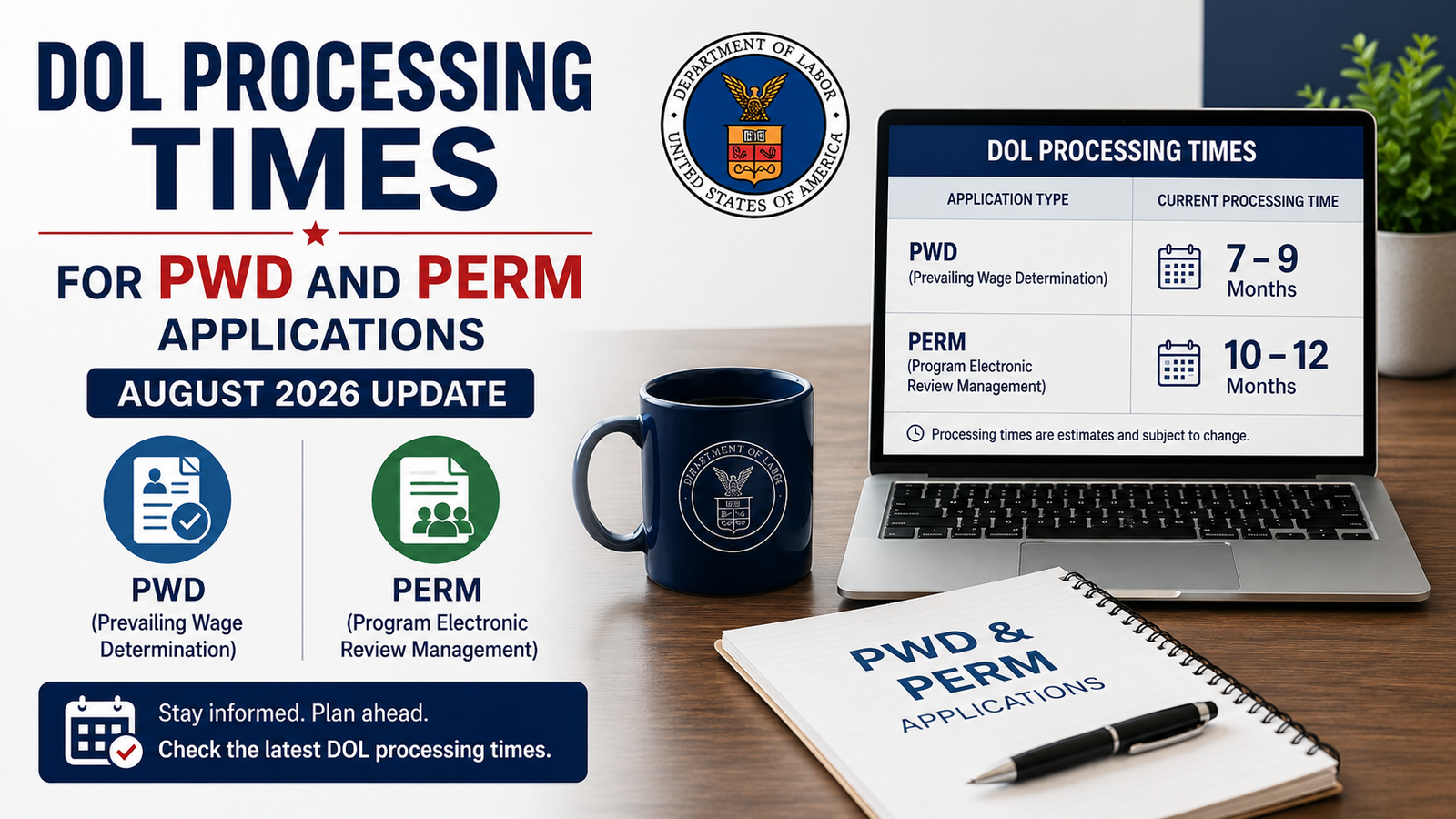
According to the latest data from the U.S. Department of Labor (DOL), the National Prevailing Wage Center (NPWC) is currently processing OEWS-based Prevailing Wage Determination (PWD) requests filed in April 2026. For PERM Labor Certification applications, the DOL is processing cases filed in September 2025, which means employers are currently looking at an average wait of around 372 days-or a little over a year.
That’s a pretty significant timeline, especially for employers planning to sponsor foreign workers for green cards. So, it’s important to build these processing times into the overall immigration strategy from the very beginning.
The DOL has recently released updated processing-time information for two major steps in the employment-based green card process: Prevailing Wage Determinations (PWDs) and PERM Labor Certification applications. The PWD data is current as of June 30, 2026, while the latest PERM processing update was published on August 7, 2026.
For employers and foreign national employees going through the PERM process, these updates are worth paying attention to. The timelines can affect when recruitment should begin, when the PERM application can be filed, and, ultimately, how long the overall green card process may take.
Below, Karan Joshi, an immigration attorney at Orange Law, breaks down what these latest processing times actually mean and what employers should keep in mind when planning an employment-based green card case.
Current PWD Processing Times (as of June 30, 2026)
The NPWC’s latest figures show the following:
- OEWS Wage Requests: Currently processing requests filed in April 2026.
- Non-OEWS Wages (including private wage surveys): Currently processing requests filed in March 2026.
- PWD Redetermination Requests: Currently reviewing requests filed in April 2026.
These are government-reported averages and can shift month to month depending on the NPWC’s workload. Individual cases can move faster or slower depending on the complexity of the wage request. In our experience at Orange Law, most PWDs are still being issued in roughly three months from filing, which lines up closely with the DOL’s own reported data.
Current PERM Processing Times (as of August 7, 2026)
The DOL’s most recent PERM update shows the agency is now working on applications filed in September 2025, putting the average PERM processing time at approximately 372 days – a little over a year from filing to certification.
A few related timelines worth noting:
- PERM Audits: The DOL is currently reviewing audit responses for cases filed in December 2025. Once a case is selected for audit, expect meaningfully longer processing on top of the standard timeline.
- Reconsideration Requests: The DOL is processing reconsideration requests filed in March 2026.
At Orange Law, non-audited PERM cases are averaging close to 12 months from filing to approval – broadly consistent with what the DOL is reporting.
Why These Timelines Matter for Employers and Foreign Workers
A one-year (or longer) PERM timeline isn’t just a number – it has real downstream effects:
- Green card timeline planning. PERM is only the first of several steps (I-140, then adjustment of status or consular processing), so delays here push out the entire timeline.
- H-1B cap and time limits. Foreign workers nearing the end of their available H-1B time depend on a timely PERM filing to qualify for extensions beyond the normal six-year limit.
- Workforce and hiring plans. Employers who wait too long to start PERM risk losing key talent or facing gaps in work authorization.
- Budget and resourcing. Longer timelines mean employers should build recruitment, prevailing wage requests, and potential audits into their hiring calendar well in advance.
Because DOL processing times shift regularly, it’s worth checking current data – and talking to immigration counsel – before setting expectations with employees or foreign national hires.
Are There Alternatives to PERM?
Not every employment-based green card path requires a PERM Labor Certification. Depending on a candidate’s background, one of these routes may be faster:
- EB-1A (Extraordinary Ability): No employer sponsorship or PERM required. Available to individuals who can show extraordinary ability in their field through sustained national or international acclaim.
- EB-2 National Interest Waiver (NIW): Also skips employer sponsorship and PERM, for candidates who can demonstrate their work is in the U.S. national interest.
Both categories are highly fact-specific. Eligibility depends heavily on the individual’s professional record, publications, awards, and overall body of work – so it’s worth a case evaluation before ruling PERM in or out.
Planning Ahead for PERM
PERM involves multiple sequential steps: obtaining a prevailing wage determination, completing DOL-mandated recruitment, and only then filing the PERM application itself. A delay at any one of these stages pushes back the whole process.
The practical takeaway: start early. Employers who begin the PERM process as soon as a role and candidate are identified – rather than waiting – give themselves the best shot at avoiding avoidable delays later in the green card journey.
Frequently Asked Questions
How long does a PERM Labor Certification take in 2026?
As of the DOL’s August 7, 2026 update, PERM applications are averaging about 372 days (roughly 12 months) from filing to a decision, based on cases filed in September 2025 now being processed.
How long does a Prevailing Wage Determination (PWD) take?
As of June 30, 2026, the DOL’s NPWC is processing OEWS-based PWD requests filed about four months earlier. Orange Law generally sees PWDs issued in around three months.
What happens if a PERM case is selected for audit?
Audited PERM cases take significantly longer than standard filings. As of the latest update, the DOL is reviewing audit responses filed in December 2025, meaning audited cases can add many additional months to the timeline.
Can I get a green card without going through PERM?
Yes, in some cases. Categories like EB-1A (Extraordinary Ability) and EB-2 National Interest Waiver (NIW) do not require a PERM Labor Certification or employer sponsorship, though eligibility depends on the individual’s qualifications.
When should an employer start the PERM process?
As early as possible. Given current processing times of roughly a year (longer if audited), employers should begin the prevailing wage and recruitment steps as soon as a position and candidate are identified, especially for foreign workers approaching H-1B time limits.
Talk to an Immigration Attorney About Your PERM Timeline
PERM processing times can change pretty often, and every case comes with its own set of challenges, especially when it comes to audits, recruitment requirements, and prevailing wage levels. So, if you’re an employer getting ready to file a PERM case or a foreign national trying to figure out your green card timeline, Orange Law can help you understand your options and put together a realistic plan.
Karan Joshi, an immigration attorney at Orange Law, works with employers and foreign nationals on PERM Labor Certification, prevailing wage strategies, and alternative green card options, including EB-1A and EB-2 NIW. If you’re not sure what path makes the most sense for your situation, you can reach out to Orange Law to discuss your case or schedule a consultation.