
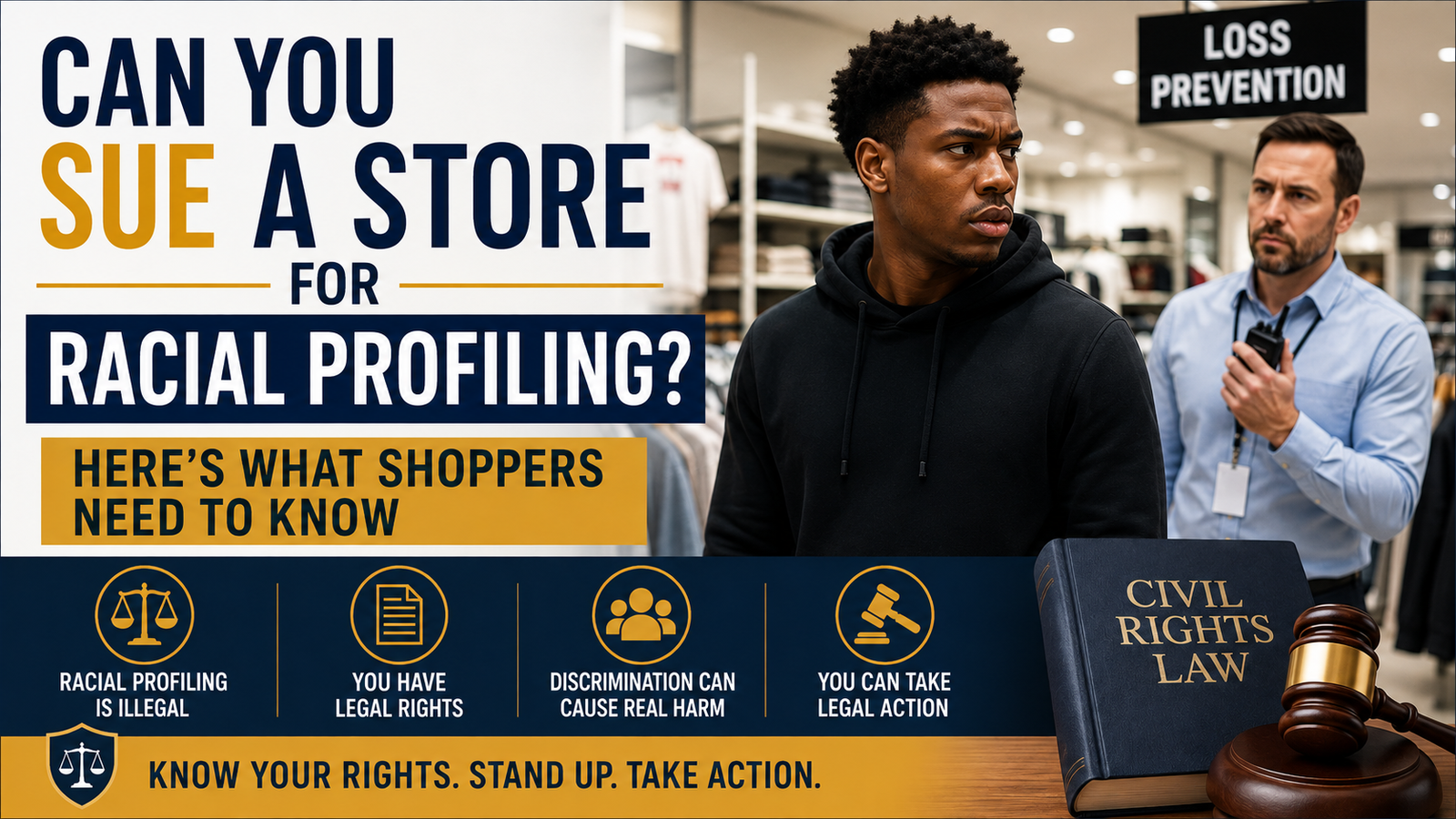
Yes, in many situations, you may be able to sue a store for racial profiling. If an employee, security guard, or manager treats you differently because of your race-like following you around the store, accusing you of stealing without a real reason, asking you for a receipt when other customers aren’t asked, or even refusing to complete your purchase-you may have a valid civil rights claim under federal or state law.
Honestly, going to the store should be a pretty normal experience. You shouldn’t have to feel like you’re being watched, questioned, or treated like a criminal just because of the color of your skin. Unfortunately, people across the country still report being followed through aisles, stopped near the exit, asked to show receipts when other shoppers aren’t, or treated like suspects the moment they walk through the door.
If you’ve experienced something like this, you’re not just imagining it, and you may have legal options. The important thing is understanding what happened, knowing when racial profiling may cross the line into unlawful discrimination, and knowing what steps you can take next.
In this guide, we’ll break it all down in simple terms-including when you may have a legal claim, which laws may protect you, and what you should do if you believe a store treated you unfairly because of your race.
What Counts as Illegal Racial Profiling in a Store?
Retailers are legally allowed to protect their merchandise and look into suspected theft. That’s not in dispute. The issue arises when race – not behavior – is the reason a customer is singled out.
Conduct that may support a legal claim includes:
- Being followed through multiple departments without any real justification
- Being accused of shoplifting with no supporting evidence
- Store staff stopping certain shoppers at the door while letting others walk out freely
- Receipt checks that only certain customers are asked to comply with
- A store associate refusing to ring up or complete your purchase
- Bag or cart searches that aren’t applied consistently to everyone
- Being detained without a reasonable basis
- Employees using racial slurs or coded, discriminatory language
Courts generally look at one central question: were other, similarly situated shoppers treated differently? If a white customer with an identical cart or an identical return would not have been stopped, questioned, or searched, that comparison can become powerful evidence in a discrimination claim.
What Laws Protect Shoppers From Racial Profiling?
Federal Law: 42 U.S.C. § 1981
One of the most important tools available to shoppers is 42 U.S.C. § 1981, a federal civil rights statute that guarantees the right to make and enforce contracts free from racial discrimination. Because purchasing something at a store is a commercial transaction, this law can apply whenever discrimination interferes with a customer’s ability to buy goods or receive the same contractual treatment as anyone else.
State Public Accommodation Laws
Most states also have their own public accommodation laws, which specifically prohibit racial discrimination in businesses that serve the public – stores, restaurants, hotels, and similar establishments. These laws often provide protections that go beyond what federal law covers, and the details vary depending on where the incident happened.
Because the applicable law depends heavily on your state and the specific facts of your case, it’s worth having an attorney review what occurred before you decide whether – or how – to move forward.
Why “Shopping While Black” Is Still a Legal Issue Today
Civil rights advocates have used the term “shopping while Black” for decades to describe a pattern: excessive surveillance, unequal security scrutiny, and the assumption that Black customers are more likely to steal. This isn’t a new problem, and it hasn’t disappeared with time – it has simply taken new forms.
A quick timeline of how the law got here:
- 1866 – Congress passed the civil rights protections that would later become 42 U.S.C. § 1981.
- 1964 – The Civil Rights Act broadened federal protections against discrimination in public life, including in businesses open to the public.
- 1990s – The phrase “shopping while Black” entered mainstream use to describe widespread reports of discriminatory retail treatment.
- 2010s–Present – Retail profiling increasingly involves security contractors, in-store surveillance systems, and automated loss-prevention tools – raising new legal questions about how bias shows up in technology, not just in person.
Retailers have faced lawsuits and settlements tied to racial profiling, discriminatory detentions, uneven receipt checks, and biased loss-prevention practices. More recently, civil rights groups have also raised concerns about facial recognition and automated surveillance in retail stores, since inaccurate matches from these systems can disproportionately flag certain racial groups.
What Evidence Should You Save After a Retail Profiling Incident?
Evidence tends to disappear fast – memories fade, security footage gets overwritten, and witnesses move on. If you believe you were racially profiled while shopping, try to preserve:
- Your receipt from the visit
- Photos or cellphone video taken during or right after the incident
- Names or physical descriptions of the employees involved
- Contact information for any witnesses
- A copy of any incident report created by the store
- A police report, if one was filed
- Any written complaint you sent to the retailer
- Emails or messages you received back from store management
It also helps to write down what happened – in your own words, in as much detail as possible – while it’s still fresh in your mind.
Frequently Asked Questions
Do I have to be arrested to sue a store for racial profiling?
No. You don’t need to have been arrested to have a claim. Discriminatory detention, searching, refusal of service, or unequal treatment can matter legally even if no arrest ever took place.
What if the store says an employee only suspected shoplifting?
That explanation doesn’t automatically end the inquiry. It gets weighed against surveillance footage, witness accounts, and – critically – how other customers in similar situations were treated.
Can I still sue if I completed my purchase anyway?
Possibly, yes. Whether you have a claim depends on the nature of the discriminatory treatment you experienced and which federal or state laws apply to your situation, not simply on whether the transaction was completed.
How long do I have to file a racial profiling lawsuit against a store?
Deadlines (statutes of limitations) vary by state and by which law your claim is based on. Because these windows can be short, it’s best to speak with an attorney as soon as possible after the incident.
Is a store liable if I was injured during a profiling incident, like being physically detained?
It can be, depending on what happened. If a store’s negligence or an employee’s conduct contributed to a physical injury during a stop or detention, that may create additional liability beyond the discrimination claim itself.
Why These Cases Matter
Retail profiling turns an ordinary errand into a degrading experience – and the harm rarely stops at the transaction itself. Being treated as a suspect because of your race sends a message that some customers are automatically distrusted simply because of who they are. Civil rights laws exist precisely to challenge that kind of unequal treatment and to protect fair access to the businesses that serve all of us.
Talk to Orange Law About Your Racial Profiling Case
Every shopper should be able to walk into a store, buy what they need, and leave without being treated like a suspect just because of their race. If you’ve ever felt like you were racially profiled or treated unfairly while shopping, it’s important to know that you may have legal options. And, honestly, you don’t have to figure all of this out on your own.
Attorney Karan Joshi and the team at Orange Law help people who have experienced racial profiling or discrimination in retail stores. They can listen to what happened, explain your rights in plain English, and help you understand whether you may have a case worth pursuing. Sometimes, simply talking to someone who understands these situations can help you figure out what to do next.