
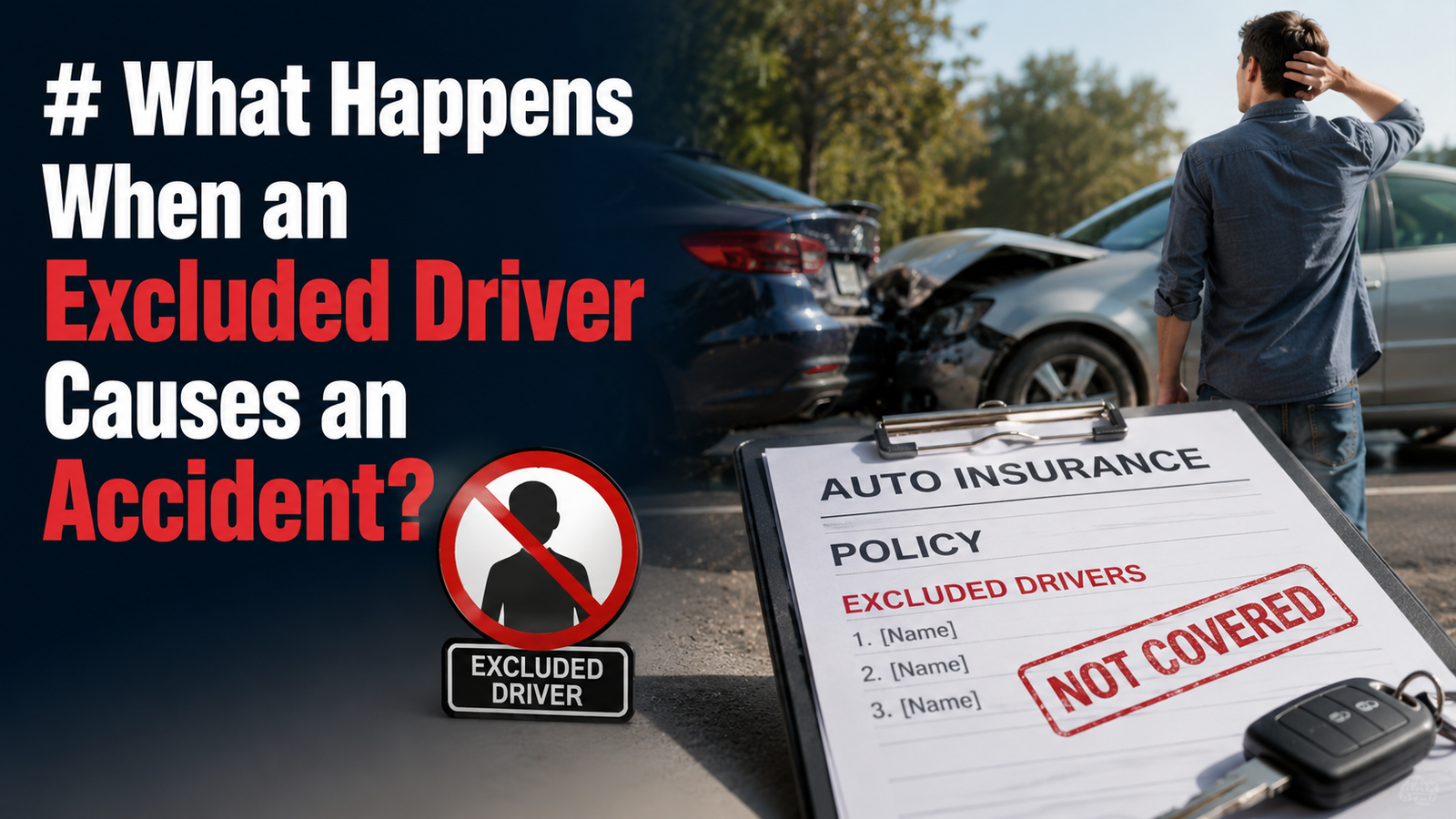
Finding out that the person who hit you was an “excluded driver” on someone else’s auto insurance policy can make an already bad situation feel even more overwhelming. You’re already dealing with medical bills, car repairs, insurance paperwork, and everything else that comes after an accident. Then you find out the driver’s insurance might not cover the crash at all.
It’s a lot to take in. But don’t panic. This kind of situation can be complicated, but once you understand how excluded-driver coverage works, things start to make a lot more sense.
When an excluded driver causes an accident, the insurance company can often deny coverage for that driver because the policy specifically says that person isn’t covered. The policyholder and insurance company agreed to that exclusion ahead of time.
But here’s the important part: a denied insurance claim doesn’t necessarily mean you’re out of options.
The driver who caused the accident may still be personally responsible for paying for your damages. Depending on your situation and the laws in your state, you may also be able to turn to your own uninsured or underinsured motorist coverage, pursue a claim directly against the at-fault driver, or look into other possible sources of compensation.
So, what happens next? ,In this article, we’ll walk through what an excluded driver actually is, what can happen when that person causes an accident, who may ultimately be responsible for your losses, and what you can do if the insurance company denies your claim.
Keep in mind, though, that insurance laws can vary quite a bit from one state to another. Your specific policy language also matters. So if you’re dealing with an excluded-driver accident, it’s a good idea to carefully review your policy and, if necessary, talk with an attorney who regularly handles these types of claims.
What Is an Excluded Driver?
An excluded driver is someone who is specifically named in an auto insurance policy as not being covered, even if they drive the insured vehicle. Basically, the policyholder has asked the insurance company to leave that person off the coverage. This is often done when someone in the household has a poor driving record, a suspended license, a DUI history, or when the policyholder simply wants to keep the insurance premium lower.
Usually, the insurance company will require the policyholder to sign a written driver exclusion form. That form identifies the excluded driver and makes it clear that the insurer won’t provide liability, collision, or other coverage if that person causes an accident while driving the insured vehicle.
Here’s a simple example. Let’s say a mother owns a car, and her adult son has several speeding tickets. She doesn’t want her insurance premium to go up, so she signs a named-driver exclusion removing her son from the policy. Later, her son borrows the car with her permission and gets into an accident. Even though she gave him permission to drive, the insurance company may deny the claim because he was specifically excluded from the policy.
And there’s an important difference between an excluded driver and someone who simply isn’t listed on the policy. If someone is excluded, they have generally been affirmatively removed from coverage, usually through a signed form. That’s a much clearer indication to the insurance company that the person isn’t covered, and it can give the insurer a stronger basis for denying a claim after an accident.
In simple terms, just because someone has permission to drive your car doesn’t necessarily mean they’re insured to drive it. If that person is specifically excluded from the policy, things can get complicated very quickly after an accident.
What Happens When an Excluded Driver Causes an Accident?
When an excluded driver causes an accident, a few different things can happen at the same time, and honestly, they don’t all work in the injured person’s favor.
First, the insurance company will usually look into whether the person who caused the crash was actually listed as an excluded driver on the policy. If the insurer confirms that they were, it may deny the liability claim based on that exclusion. In other words, the policy may not cover the accident because that particular driver was specifically excluded.
But here’s the important part: just because the insurance company refuses to pay doesn’t mean the driver is off the hook. The excluded driver can still be legally responsible for the damage they caused. Depending on the circumstances, the injured person may be able to file a personal injury lawsuit directly against the driver to recover compensation.
At that point, the injured person may need to look at other possible ways to recover their losses. For example, they might have uninsured or underinsured motorist coverage on their own auto insurance policy. There may also be situations where the vehicle owner could be held responsible under state law. And, of course, a claim may still be possible directly against the driver who caused the accident.
So, basically, an excluded driver accident can close one major door-the vehicle’s liability insurance-but that doesn’t necessarily mean every option is gone. There may still be other ways to pursue compensation.
The tricky part is that the answer can vary quite a bit depending on your state’s laws, the exact wording of the insurance policy, and what happened in the accident. That’s why it’s a good idea to have the policy and the circumstances of the crash reviewed carefully before assuming the claim has nowhere to go.
Does Insurance Cover an Accident Caused by an Excluded Driver?
Generally, no – the insurance policy that lists the exclusion will typically deny coverage for an accident caused by that named excluded driver, since the exclusion was specifically negotiated and agreed to by the policyholder.
That said, “generally no” isn’t the same as “always no.” A few things can affect the outcome:
- Policy language. Some exclusions are broadly written and apply to any use of the vehicle. Others are narrower. The exact wording matters.
- State law. Some states allow broad named-driver exclusions with few restrictions. Other states have adopted rules that limit how exclusions apply, particularly when it comes to protecting injured third parties.
- Permissive use. If the excluded driver had permission to drive the vehicle, that generally doesn’t override the exclusion, but the facts of how the vehicle was obtained can still matter to how the case is evaluated.
- Whether the exclusion was properly executed. If there’s a dispute about whether the exclusion form was valid, signed, or provided to the right party, that can become a contested issue.
Because auto insurance exclusion rules aren’t uniform across the country, it’s worth having someone actually look at the policy and the applicable state law rather than assuming the outcome based on a general rule of thumb.
Who Pays for the Damages After an Excluded Driver Accident?
This is usually the question people care about most, and the honest answer is: it depends on several overlapping factors. Here’s how responsibility typically breaks down.
The excluded driver. They can generally still be held personally liable for the crash. A denied insurance claim doesn’t mean the driver has no legal responsibility – it just means their own insurance policy won’t be the one paying.
The vehicle owner or policyholder. Depending on state law, a vehicle owner may face liability in certain circumstances, particularly if they knowingly allowed a dangerous or unqualified driver to use the car despite the exclusion. This is fact-specific and varies by jurisdiction.
The insurance company. In most cases, once a valid exclusion is confirmed, the insurer isn’t required to pay a liability claim tied to that driver. However, insurers still have to properly investigate and apply the exclusion correctly, and disputes over how they handled the claim do arise.
The injured person’s own insurance. This is often the most realistic path to compensation. Uninsured motorist coverage (UM) and underinsured motorist coverage (UIM), if you carry it, may respond when the at-fault driver’s policy doesn’t cover the accident.
Other potentially responsible parties. Depending on the accident, other factors — a third-party vehicle, a defective auto part, a government entity responsible for road conditions – could also play a role. These situations are less common but worth mentioning to whoever reviews your case.
Because these categories can overlap or conflict, sorting out who actually pays often takes a genuine review of the policy, the accident details, and applicable state law.
Can an Insurance Company Deny a Claim Because the Driver Was Excluded?
Yes, in general, insurance companies can and do deny claims when the at-fault driver was specifically named as an excluded driver on the policy in effect at the time of the crash.
Before denying a claim, an insurer will typically verify a few things:
- Whether a valid, signed exclusion form exists for that driver.
- Whether that person was actually driving at the time of the accident.
- Whether the vehicle involved is the one covered by the policy containing the exclusion.
- Whether state law places any limits on enforcing the exclusion in this situation.
If any of those points are unclear or disputed, the denial isn’t necessarily the final word. Insurance companies sometimes deny claims that are later reevaluated or challenged once policy language and state law are examined more closely. This is exactly the kind of situation where reviewing the denial letter and the underlying policy carefully – rather than accepting the denial at face value – can matter.
What If You Are Injured by an Excluded Driver?
If you’ve been hurt in a crash and later learn the at-fault driver was excluded from the insurance policy, here’s a practical roadmap.
- Seek medical attention. Your health comes first, and prompt medical records also document your injuries in case you need them later.
- Report the accident. File a police report if you haven’t already, and report the crash to your own insurance company, even if the other driver was at fault.
- Preserve evidence. Photos of the scene and vehicles, witness contact information, and any dashcam footage can matter more than people expect, especially in a disputed claim.
- Get the insurance information. Note the at-fault driver’s insurance details and the vehicle owner’s information, since both may become relevant.
- Avoid giving unnecessary recorded statements. Be cautious about giving detailed recorded statements to the other driver’s insurance company before understanding how the exclusion issue might affect your claim.
- Review your own insurance coverage. Check whether you have uninsured or underinsured motorist coverage, medical payments coverage, or other policies that might apply.
- Consider speaking with a lawyer. Especially if the claim is denied, injuries are significant, or liability is disputed, a car accident lawyer can help you understand what coverage might actually be available in your situation.
What Insurance Coverage May Still Be Available?
Even when the at-fault driver’s policy won’t pay because of the exclusion, other coverage sources sometimes fill the gap.
Uninsured motorist coverage (UM). If the excluded driver is treated as effectively uninsured for purposes of the accident, your own UM coverage – if you have it – may apply. Many states allow this, though the specifics vary and some states don’t require UM coverage at all.
Underinsured motorist coverage (UIM). If there’s some coverage available but it isn’t enough to cover your damages, UIM coverage on your own policy may help make up the difference, depending on your policy limits and state rules.
Med-pay or personal injury protection (PIP). Depending on your state and your own policy, medical payments coverage or PIP may help cover medical expenses regardless of fault.
Other applicable policies. In some cases, a resident relative’s policy, an umbrella policy, or coverage tied to the vehicle owner may come into play, depending on the facts.
Whether any of these apply to your excluded driver accident depends entirely on what coverage you personally carry and what your state allows. This is a good area to review with your own insurance agent or an attorney, since UM/UIM coverage in particular is often underused simply because people don’t realize they have it.
Can You Sue an Excluded Driver After an Accident?
Yes. You can file a personal injury lawsuit against an excluded driver, but it’s important to understand that a lawsuit is a separate thing from an insurance claim. The two are not the same.
With an insurance claim, you’re asking an insurance company to cover your damages under an insurance policy. A lawsuit, on the other hand, is a legal action against the person who caused the accident-or, in some cases, another party that may be legally responsible. The goal is to hold them personally responsible for your injuries and other losses.
But here’s the thing: winning a lawsuit doesn’t automatically mean you’ll get paid. If the excluded driver doesn’t have enough personal assets, income, or another insurance policy that could cover the damages, collecting on a judgment can be difficult-even if the court rules in your favor.
That’s why it’s really important to look at all of your possible options. For example, your own UM/UIM coverage may provide another potential source of compensation, depending on your policy and the circumstances of the accident. In some situations, that may be a much more practical path than trying to collect directly from the excluded driver.
An attorney can look at the specific facts of your case and help you figure out whether suing the excluded driver actually makes sense-or whether there are other options that are more likely to help you recover the compensation you need.
What Should You Do If Your Insurance Claim Is Denied?
A denied insurance claim after an excluded driver accident isn’t necessarily the end of the road. Here’s what’s generally worth doing next.
- Get the denial in writing and read the stated reason carefully. Insurers are typically required to explain why a claim was denied.
- Request a copy of the policy and the exclusion form referenced in the denial, if you don’t already have them.
- Check the timeline. Confirm when the exclusion was signed relative to the accident date, since a recently added or improperly documented exclusion can sometimes be relevant.
- Look into your own coverage for UM/UIM or other applicable policies, as discussed above.
- Consider a formal appeal if your state or the insurer allows one, and keep records of all correspondence.
- Talk to a lawyer before assuming the denial is final, particularly if there’s a real dispute about the accident, the exclusion, or how much you’re owed.
This is one of the situations where the team at Orange Law regularly hears from people – after a denied insurance claim leaves them unsure what to do next. A denial letter can sound very final, but it’s really the insurance company’s position, not necessarily the last word on what you’re entitled to.
When Should You Contact a Car Accident Lawyer?
Not every accident requires a lawyer. But an excluded driver accident often raises exactly the kind of complications where legal guidance becomes genuinely useful rather than optional.
Consider speaking with a car accident lawyer or personal injury lawyer if:
- You suffered serious or long-term injuries.
- Liability for the crash is disputed.
- Your insurance claim, or the at-fault driver’s claim, has been denied.
- Multiple insurance policies might apply, and it’s unclear which one should pay.
- The damages involved are significant relative to available coverage.
- You’re unsure whether the exclusion was even validly applied to your situation.
A car accident lawyer at a firm like Orange Law can review the policy language, the exclusion documentation, and your state’s specific rules to help you understand what coverage might realistically be available and what your options look like. This kind of review often catches details – like an improperly executed exclusion form or an overlooked UM/UIM policy – that aren’t obvious without someone examining the paperwork closely.
Frequently Asked Questions
What happens if an excluded driver gets into an accident?
The insurance company will typically deny liability coverage for that driver under the policy listing the exclusion. The driver may still be personally liable for the damages, and the injured person may have other options, such as their own uninsured motorist coverage, depending on the state and the specific facts.
Is an excluded driver covered by insurance?
Usually not, if they are the one driving and caused the accident. The whole point of a named-driver exclusion is to remove that person from coverage under the policy. Coverage for other drivers or passengers in the vehicle may still apply, depending on the policy.
Can I sue an excluded driver after an accident?
Yes, generally you can pursue a personal injury claim against the excluded driver individually, separate from any insurance claim. Whether that results in actual compensation depends on whether the driver has personal assets or other applicable insurance to satisfy a judgment.
Who pays if an excluded driver causes a crash?
It depends on the facts. Potentially responsible parties include the excluded driver personally, in some cases the vehicle owner, and possibly your own insurance company through uninsured or underinsured motorist coverage, depending on your state and policy.
Can my uninsured motorist coverage help?
Possibly. If the excluded driver is treated as effectively uninsured for the accident, your own uninsured motorist coverage may apply, assuming you carry that coverage and your state allows it in this situation.
Can an insurance company deny my claim because the driver was excluded?
Yes, insurers can generally deny liability claims once a valid named-driver exclusion is confirmed for the at-fault driver. The denial should still be reviewed carefully, since disputes over the exclusion’s validity or the policy’s wording do come up.
What should I do if the insurance company denies my accident claim?
Request the denial in writing along with the policy and exclusion documents, review your own insurance coverage for potential UM/UIM benefits, and consider having a lawyer review the denial before treating it as final.
Should I talk to a lawyer after an excluded driver accident?
It’s worth strongly considering, especially if you were seriously injured, your claim was denied, or liability is disputed. A lawyer can review the exclusion, the policy, and your state’s law to help clarify what compensation may actually be available.
Final Thoughts
Finding out that an excluded driver was involved in the accident you were in can be really frustrating. You may feel like the insurance company is already working against you. But the thing is, an insurance denial doesn’t necessarily mean you’re out of options.
Depending on the situation, there may be other ways to seek compensation. For example, the driver may have personal liability for the accident, or you may be able to use your own uninsured or underinsured motorist coverage. There could also be other potential sources of recovery worth looking into.
Of course, every case is different. What happens next can depend on the exact language in the insurance policy, the laws in your state, and what actually happened in the crash. So, honestly, it’s difficult to know what your options are without taking a closer look at the details.
If you were injured in an accident involving an excluded driver and you’re not sure what to do next-especially if your insurance claim has been denied or you’re dealing with serious injuries-the team at Orange Law can help you understand your options. They can review the accident, your insurance policy, and the circumstances of your claim with you.
There’s no obligation to move forward just because you ask for a case evaluation. It can simply help you get a better understanding of where you stand, what compensation you may be entitled to, and what steps you can take next.