
If your family member’s or employee’s immigrant visa has been delayed, denied, or stuck in limbo over the past few months, there’s a good chance the 75-country Immigrant visa ban had something to do with it.
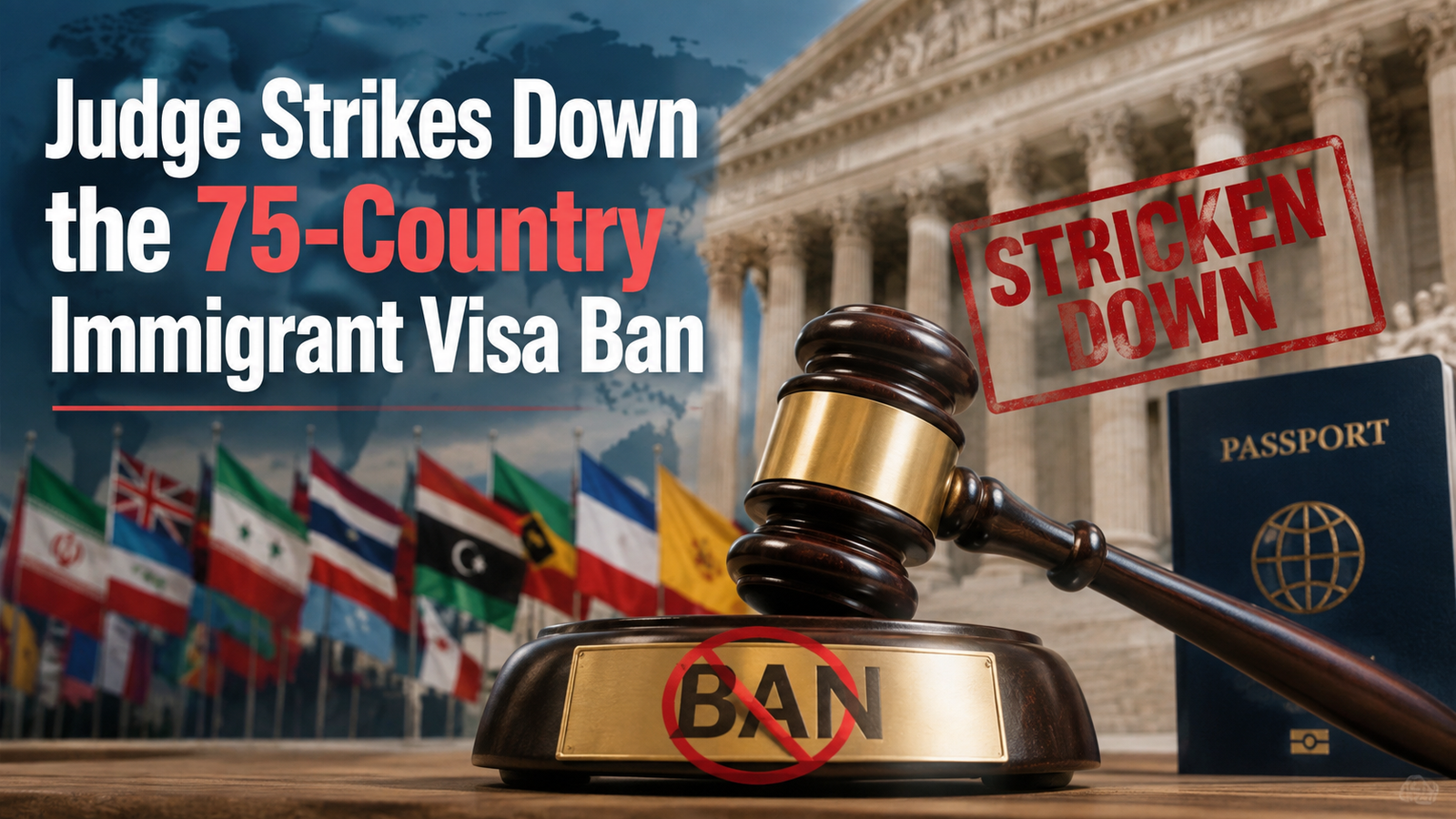
The good news is that a federal court has now struck down that policy. For thousands of applicants, that could mean their cases finally get a real, individual review instead of being held up simply because of where they were born.
At Orange Law, we’ve been hearing from families and employers who were basically told, in one way or another, that the visa just wasn’t going to happen because of the applicant’s country of birth. Understandably, that left a lot of people frustrated and unsure about what to do next.
This ruling changes the situation,So, let’s break down what happened, why the court struck down the policy, and, most importantly, what you should actually do if your case was affected.
What Was the 75-Country Visa Policy, Exactly?
Back in January 2026, the State Department quietly introduced a sweeping policy that indefinitely suspended immigrant visa processing for nationals of 75 countries. And this wasn’t a small list-it covered nearly 40% of the countries in the world, including Afghanistan, Brazil, Colombia, Egypt, Haiti, Iran, Russia, Somalia, Yemen, and many others.
The official reasoning was concerns that some immigrants might eventually rely on U.S. public benefits, which falls under the “public charge” ground of inadmissibility. Normally, this is supposed to be an individualized assessment. In other words, a consular officer is expected to look at things like your age, health, financial situation, education, and job skills before deciding whether you’re likely to become a public charge.
But here’s where the January 2026 policy was different,Instead of looking at each applicant’s individual circumstances, the 75-country policy essentially applied a blanket presumption to people from the listed countries. So even if an applicant could clearly demonstrate that they were financially self-sufficient and unlikely to depend on government assistance, the policy could still prevent their immigrant visa from being processed.
In practical terms, that meant qualified family members and employment-based immigrants could face a roadblock not because of something specific about their case, but simply because of their nationality.
One important point, though: this policy applied only to immigrant visas. Those are the visas used for people seeking permanent immigration to the United States through family sponsorship, employment, or other immigrant categories.
It did not apply to nonimmigrant visas under this particular policy. So common temporary visa categories, such as B-1/B-2 visitor visas and F-1 student visas, were not affected by this specific suspension.
So, in simple terms, the biggest change was that a process that would normally focus on an individual applicant’s circumstances was replaced with a much broader country-based restriction.
Why Did the Court Strike It Down?
On August 21, 2026, U.S. District Judge Jeannette Vargas of the Southern District of New York struck down the policy. Basically, her decision came down to two major problems with the way the State Department had set up the rule.
First, federal immigration law gives individual consular officers the authority to decide whether a particular visa applicant qualifies. In other words, the government generally can’t make a blanket decision that automatically affects everyone from a certain country without looking at each person’s individual case.
Second, the Immigration and Nationality Act (INA) specifically prohibits nationality-based discrimination when it comes to issuing immigrant visas. The court found that the 75-country policy conflicted with both of these principles because it essentially decided the outcome based on a person’s nationality before a consular officer even had a chance to review the applicant’s file.
The administration also pointed to the Supreme Court’s 2018 decision, which upheld an earlier version of the travel ban, to support its position. But Judge Vargas wasn’t persuaded by that comparison.
The key difference, according to the court, is that the earlier case dealt with the president’s authority to decide who can enter the United States. This case was about something different: whether the State Department could prevent its own consular officers from issuing visas to applicants who were otherwise legally eligible.
So, in simple terms, the court viewed these as two separate legal questions. A president’s authority over entry into the country isn’t necessarily the same thing as the State Department’s authority to impose a blanket restriction on visa decisions. That distinction was a major part of Judge Vargas’s reasoning.
What This Means If Your Visa Was Delayed or Denied
This is the part that actually matters for your case, so let’s break it down plainly.
The policy can no longer be used to justify a refusal. Going forward, nationality from one of the 75 countries cannot, by itself, be a reason to deny an immigrant visa.
Past denials based solely on the policy have been set aside. If your case was refused only because of the 75-country rule – not for any other independent legal reason – that refusal has effectively been undone. Your case should now go back to a consular officer for a normal, individualized review.
This is not an automatic approval. This is the point people miss most often. The ruling restores your right to a fair, case-by-case review – it doesn’t guarantee an approved visa. You still have to meet every other eligibility requirement, including the standard public charge test and any other grounds of inadmissibility that may apply to your situation.
Denials on separate grounds still stand. If you were refused for a reason unrelated to the 75-country policy – say, a prior immigration violation or a different inadmissibility issue – this ruling doesn’t touch that decision.
Could the Ban Come Back?
It’s possible. The administration retains the right to appeal Judge Vargas’s decision, and the litigation isn’t fully closed – the court gave the parties until September 11, 2026, to submit proposals on how to handle the remaining pieces of the case. For now, though, the ruling stands, and case-by-case review is the rule again for affected applicants.
Who Brought the Case?
The lawsuit was filed by the Catholic Legal Immigration Network (CLINIC) and African Communities Together, along with 11 individual plaintiffs. These included six U.S. citizens who had filed family-based petitions for relatives living abroad and five people pursuing employment-based green cards.
Their argument was pretty straightforward: people who had met all the legal requirements for their immigration applications were being blocked simply because of where they came from. And, honestly, that’s the problem. Their position was that immigration decisions should be based on the law and the applicant’s eligibility-not their country of origin.
What Should You Do Next?
If you believe your case was affected by the 75-country suspension, here’s a practical starting point:
- Pull your case history. Check whether your denial or delay cited the public charge suspension or nationality-based restrictions specifically.
- Watch for a status update. Cases that were paused or refused solely under the policy should start moving back through normal consular processing, though timing will vary post by post.
- Get your documentation in order. Since a genuine public charge review looks at income, assets, education, and job prospects, having that evidence ready can speed things along once your case is back in front of an officer.
- Talk to an immigration attorney before you do anything else. Every case has its own procedural history, and the right next step – requesting reconsideration, submitting new evidence, or simply waiting for the consulate to act – depends entirely on the specifics of your file.
How Orange Law Can Help
Court rulings like this one open a door, but walking through it correctly still takes legal strategy. At Orange Law, we help clients:
- Review whether a prior visa denial or delay was tied to the 75-country policy
- Prepare and strengthen documentation for a public charge determination
- Communicate with the relevant consulate or National Visa Center on next steps
- Plan for family-based and employment-based immigrant visa cases affected by this and related policy changes
If your case has been sitting in limbo, this ruling is a real opportunity to get it moving again – but only if it’s handled the right way. Schedule a consultation with Orange Law today, and let’s find out exactly where your case stands and what comes next.
Frequently Asked Questions
What is the 75-country immigrant visa ban?
It was a State Department policy, introduced in January 2026, that indefinitely suspended immigrant visa issuance to nationals of 75 countries based on public charge concerns, without individual review of each applicant.
Has the 75-country visa ban been struck down?
Yes. On August 21, 2026, a federal judge in the Southern District of New York vacated the policy, ruling it exceeded the State Department’s legal authority and violated the ban on nationality-based discrimination in immigrant visa issuance.
Does this ruling mean my visa will automatically be approved?
No. It restores your right to an individualized review. You still need to meet all other visa eligibility requirements, including the standard public charge assessment.
Which visas were affected by the 75-country ban?
Only immigrant visas – family-based and employment-based green card cases. Nonimmigrant visas such as tourist and student visas were never part of this suspension.
Can the visa ban be reinstated?
It’s possible. The administration can appeal the ruling, and further proceedings in the case are ongoing, with a court deadline of September 11, 2026, for additional filings.
What should I do if my visa was denied under this policy?
Speak with an immigration attorney to review your case file, confirm whether the denial was based solely on the 75-country policy, and determine the right next step for reconsideration.