
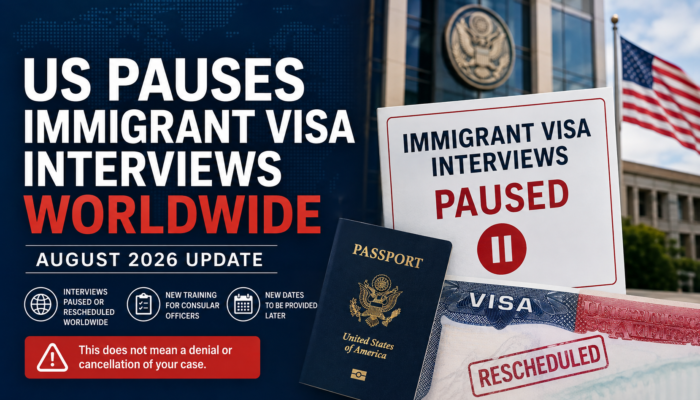
The U.S. Department of State has paused or rescheduled immigrant visa appointments at U.S. embassies and consulates worldwide while consular officers undergo new training focused on evaluating visa applicants, including whether applicants may be likely to become dependent on public benefits.
The development affects applicants seeking immigrant visas through consular processing outside the United States. Applicants who already had interviews scheduled have reportedly received notices that their appointments are being rescheduled, with new dates to be provided later. The State Department has not announced when regular immigrant visa appointment scheduling will resume.
This development should not be described as a suspension of all U.S. visa interviews. The current reporting concerns immigrant visa appointments. Nonimmigrant visa categories are subject to separate processing and appointment procedures.
For individuals with pending immigrant visa cases, the immediate concern is what the appointment pause means for their case, whether a postponed interview affects their immigration status, and what they should do while waiting for further instructions.
What Happened to US Immigrant Visa Interviews?
Short answer: The State Department has paused or rescheduled immigrant visa appointments worldwide while consular officers complete new training on visa screening and public-charge considerations.
According to Reuters, the State Department launched a global training initiative for consular officers in early August. Applicants who already had immigrant visa interviews scheduled have reportedly received notices that their appointments are being rescheduled, with new appointment dates to be provided later. No date has been announced for the return to normal appointment scheduling.
The change concerns immigrant visa processing at U.S. embassies and consulates outside the United States. It therefore has particular significance for people completing consular processing as part of a family-based or employment-based immigration case.
The appointment disruption should be distinguished from a visa denial or the cancellation of an underlying immigration petition. A postponed interview is a scheduling development; it is not, by itself, a decision that an applicant is ineligible for an immigrant visa.
Why Is the US Pausing Immigrant Visa Appointments?
Short answer: The State Department says the training is intended to ensure that consular officers evaluate visa applicants comprehensively and consistently, with particular attention to whether applicants could become a public charge.
Public-charge inadmissibility is already part of U.S. immigration law. Section 212(a)(4) of the Immigration and Nationality Act establishes a ground of inadmissibility relating to an immigrant who is determined to be likely to become a public charge. The Department of State identifies factors that may be considered in making that determination.
The current development is therefore not the creation of the public-charge concept itself. Rather, the State Department is undertaking new training for consular officers concerning how immigrant visa applicants should be evaluated.
The government has not publicly provided a complete description of the training or announced how long the appointment disruption will continue. Applicants should therefore be cautious about relying on unofficial claims regarding a specific resumption date.
What Is the Public Charge Rule?
The public-charge assessment is part of the existing immigration-law framework. The Department of State explains that consular officers consider the totality of an applicant’s circumstances when determining whether the public-charge ground applies. Relevant considerations can include financial and personal circumstances.
The assessment may involve factors such as:
- Age
- Health
- Family status
- Assets and resources
- Financial status
- Education
- Skills
- Financial sponsorship, where applicable
An applicant should not assume that one financial document alone determines the outcome of a public-charge assessment. The applicable rules require consideration of the relevant circumstances of the individual case.
The State Department has also introduced a Public Charge Bond procedure for certain immigrant visa applicants. The department announced that consular officers may require selected applicants to apply for a bond through USCIS.
That development is separate from the current worldwide appointment scheduling disruption, although both involve the government’s increased focus on public-charge considerations.
Summary: The public-charge rule is a U.S. immigration inadmissibility provision under which certain immigrants may be found ineligible for a visa if they are determined to be likely to become a public charge.
Which Immigrant Visa Applicants May Be Affected?
why it matters: Immigrant visa applicants completing consular processing outside the United States may be affected, including applicants in family-based and employment-based immigration categories.
The reported pause applies to immigrant visa appointments at U.S. embassies and consulates worldwide. This can affect applicants who need a consular interview before an immigrant visa can be issued.
Potentially affected applicants include:
- Family-sponsored immigrant visa applicants
- Immediate relatives of U.S. citizens
- Family-preference applicants
- Employment-based immigrant visa applicants
- Other immigrant visa applicants completing consular processing
The precise effect on an individual case depends on factors including the applicant’s visa category, case status, consular post and whether an interview has already been scheduled.
It is also important to distinguish visa-number availability from interview scheduling. An immigrant visa case may be subject to the Visa Bulletin and visa-number limits while also being affected by appointment scheduling at the relevant consular post.
Does This Mean All US Visa Interviews Are Suspended?
Short answer: No. The current development concerns immigrant visa appointments and does not establish a blanket suspension of every U.S. visa interview.
The United States has separate immigrant and nonimmigrant visa systems. The current reporting concerns the appointment process for immigrant visas.
That means headlines stating that “all U.S. visa interviews have been cancelled worldwide” would be broader than the confirmed information supports.
For example, the following categories should not automatically be treated as suspended solely because of this immigrant visa appointment pause:
- Visa category Effect of the current immigrant visa appointment pause
- Family-based immigrant visas May be affected when processed through consular processing
- Employment-based immigrant visas May be affected when processed through consular processing
- Other immigrant visa categories May be affected depending on the case and consular post
- B1/B2 visitor visas Not covered by this specific immigrant-visa announcement
- F1 student visas Not covered by this specific immigrant-visa announcement
- H-1B nonimmigrant visas Not covered by this specific immigrant-visa announcement
This does not mean that nonimmigrant visa applicants are immune from other visa-policy changes. The Department of State has separate policies governing nonimmigrant visa screening and appointments.
The key distinction is that the August 2026 development concerns immigrant visa appointments.
Does the Pause Affect Green Card Applicants?
Short answer: It can affect people seeking permanent residence through consular processing because an immigrant visa interview is generally part of the process for obtaining an immigrant visa abroad.
A person outside the United States who is immigrating through consular processing generally must complete the immigrant visa process through the Department of State and the appropriate U.S. embassy or consulate.
The current appointment disruption may therefore delay the interview stage for applicants whose cases are otherwise ready for an interview.
However, an interview postponement should not be treated as a cancellation of the applicant’s green card petition or as an automatic denial of the immigrant visa.
Those are separate legal and procedural matters.
What Happens If Your US Immigrant Visa Interview Was Cancelled?
Key point: A postponed immigrant visa interview does not, by itself, mean that the applicant’s immigration case has been denied or cancelled.
Applicants who receive a cancellation or rescheduling notice should carefully review the communication from the U.S. embassy or consulate handling their case.
Until further instructions are provided, applicants should generally:
- Monitor the email address associated with the case.
- Check communications from the relevant embassy or consulate.
- Monitor the applicable visa appointment system.
- Keep required immigration documents current.
- Continue preparing for the eventual interview.
- Follow any rescheduling instructions issued by the government.
- Avoid relying on unofficial websites or social-media posts for a new interview date.
Applicants should also be careful about making non-refundable travel arrangements when an interview date has not been officially confirmed.
Does a Cancelled Interview Mean My Visa Application Was Denied?
No. A cancelled or postponed interview is not the same as an immigrant visa refusal.
A consular officer’s refusal of an immigrant visa is a legal determination based on the applicant’s eligibility or inadmissibility under applicable law.
The current appointment disruption concerns the scheduling of immigrant visa interviews while consular officers undergo the new training. Reuters reports that affected applicants are being told that interviews will be rescheduled.
Applicants should therefore distinguish between:
- Appointment postponement: The interview is moved or delayed.
- Visa refusal: The government determines that the applicant cannot receive the visa under applicable law.
A postponed interview does not automatically establish the second outcome.
Will Cancelled US Immigrant Visa Interviews Be Rescheduled?
The State Department has not announced a date when normal immigrant visa appointment scheduling will resume worldwide.
The timing of future appointments may also depend on the individual consular post and the volume of pending cases.
Applicants should therefore wait for official communication rather than assuming that all U.S. embassies and consulates will resume interviews on the same date.
When Will US Immigrant Visa Interviews Resume?
Short answer: As of August 26, 2026, the State Department has not announced when regular immigrant visa appointment scheduling will fully resume.
The absence of a published resumption date means applicants should not rely on predictions circulating online.
A specific date should be treated as confirmed only when it is communicated by the Department of State or the U.S. embassy or consulate handling the applicant’s case.
This is particularly important for applicants making travel arrangements, planning medical examinations or coordinating employment and family relocation.
Summary: Applicants whose interviews have been postponed have reportedly been told that new appointment dates will be provided, but there is currently no universal rescheduling timetable.
Does the US Immigrant Visa Pause Affect Applicants in India?
Short reply: Indian applicants pursuing immigrant visas through consular processing may be affected because the reported appointment pause applies worldwide.
Applicants in India should monitor communications from the U.S. consular post handling their immigrant visa case.
The State Department maintains official immigrant visa information and scheduling resources for consular posts. Applicants should use those resources rather than relying solely on visa agents, consultants or unofficial appointment-slot websites.
The same distinction between immigrant and nonimmigrant visas applies in India. A worldwide pause affecting immigrant visa appointments should not automatically be interpreted as a suspension of B1/B2, F1, H-1B or other nonimmigrant visa interviews.
Is the Current Pause Related to the Earlier 75-Country Immigrant Visa Restriction?
Short answer: The current appointment pause and the earlier 75-country immigrant visa restriction are separate policies, although both involve the administration’s focus on immigrant visa screening and public-benefit reliance.
The State Department previously announced that, effective January 21, 2026, it had paused visa issuance to immigrant visa applicants who were nationals of 75 countries.
A federal judge subsequently ruled against that separate policy, according to Reuters. The ruling concerned the government’s authority to categorically suspend immigrant visa issuance on that basis.
The current worldwide appointment disruption is different.
Rather than being limited to nationals of specified countries, the current development concerns a global training initiative for consular officers and the resulting pause or rescheduling of immigrant visa appointments.
That distinction is important for applicants trying to understand the current situation.
Does the Pause Stop Immigrant Visa Processing Completely?
Short answer: No. The reported development concerns immigrant visa appointment scheduling and should not be described as the complete termination of immigrant visa processing.
Immigrant visa processing involves multiple stages. Depending on the case, these can include an approved petition, document processing, visa-number availability, National Visa Center processing and a consular interview.
The Department of State continues to publish immigrant visa information and maintain its visa-related resources. Its Visa Bulletin separately addresses immigrant visa-number availability.
This means applicants should distinguish between:
- Petition processing
- Document processing
- Visa-number availability
- Interview scheduling
- Visa adjudication
- Visa issuance
A delay at the interview-scheduling stage does not necessarily mean that every other part of an immigrant visa case has stopped.
What Should Immigrant Visa Applicants Do Now?
Applicants should monitor official government communications, keep their documentation ready and avoid treating an appointment postponement as a visa denial.
For most applicants, the practical priority is preparation and monitoring.
- Monitor Your Case
- Check the email address and appointment account associated with your immigrant visa case.
- Keep Your Documents Ready
- Do not stop preparing simply because an interview has been postponed. Documents can have expiration dates, so applicants should also determine whether updated versions will be required before the eventual interview.
- Follow the Embassy’s Instructions
- If the embassy or consulate sends specific instructions, those instructions should take priority over general information published elsewhere.
- Avoid Unconfirmed Travel Plans
- Applicants should be cautious about purchasing non-refundable flights or making other major arrangements until an interview date is confirmed and the visa has been issued.
- Do Not Assume You Need to Start Over
- A postponed interview does not automatically mean that an applicant must file a new petition or restart the entire immigrant visa process.
If the government provides specific instructions requiring additional action, applicants should follow those instructions.
What Is the Difference Between an Immigrant Visa Appointment Pause and a Visa Ban?
An appointment pause primarily affects the timing of an interview, while a visa ban or issuance restriction can prevent visas from being issued to specified people or categories.
These terms should not be used interchangeably.
An appointment pause concerns the scheduling or conduct of interviews.
A visa issuance restriction concerns whether the government may issue visas to particular applicants or categories.
A visa denial is an adjudicative decision concerning a particular applicant’s eligibility or inadmissibility.
Because these actions have different legal consequences, applicants should look at the specific notice they receive rather than relying on a general headline about a “visa ban.”
Frequently Asked Questions About the US Immigrant Visa Interview Pause
Did the US pause visa interviews worldwide?
The State Department has paused or rescheduled immigrant visa appointments worldwide while consular officers undergo new training. This is not a blanket suspension of every U.S. visa category.
Are all US visa interviews cancelled?
No. The current development concerns immigrant visa appointments. It should not be characterized as a worldwide cancellation of all immigrant and nonimmigrant visa interviews.
Why did the US pause immigrant visa interviews?
The State Department’s training initiative is focused on comprehensive and consistent screening of immigrant visa applicants, including public-charge considerations.
When will US immigrant visa interviews resume?
The State Department has not announced a date for the full resumption of regular immigrant visa appointment scheduling worldwide.
What happens if my US immigrant visa interview is cancelled?
Applicants should monitor communications from the U.S. embassy or consulate handling their case and follow any instructions regarding rescheduling.
Does a cancelled immigrant visa interview mean my case was denied?
No. A postponed interview is not, by itself, a visa refusal or a determination that the underlying immigration case has been denied.
Will my cancelled interview automatically be rescheduled?
Affected applicants have reportedly been told that new dates will be provided, but there is currently no universal rescheduling timetable.
Are family-based immigrant visa applicants affected?
Family-based applicants undergoing immigrant visa processing through U.S. consular posts may be affected by the appointment disruption.
Are employment-based immigrant visa applicants affected?
Employment-based applicants completing immigrant visa processing through a U.S. embassy or consulate may also be affected by the appointment disruption.
Are B1/B2 tourist visa interviews paused?
The current announcement concerns immigrant visa appointments. It should not be interpreted as a blanket pause of B1/B2 nonimmigrant visa interviews.
Are F1 student visa interviews paused?
The current immigrant visa appointment pause does not establish a blanket suspension of F1 student visa interviews.
Are H-1B visa interviews paused?
The current development concerns immigrant visa appointments and does not establish a blanket suspension of H-1B nonimmigrant visa interviews.
Does the pause affect Indian applicants?
The reported pause is worldwide for immigrant visa appointments, so Indian applicants completing immigrant visa processing through U.S. consular posts should monitor official communications about their cases.
What is a public charge?
Public-charge inadmissibility is a ground under U.S. immigration law that can affect certain immigrant visa applicants who are determined to be likely to become a public charge. The applicable assessment considers the circumstances of the individual applicant.
Is the public charge rule new?
No. Public-charge inadmissibility is part of existing U.S. immigration law. The current development involves new State Department training and an increased focus on how consular officers evaluate applicants.
Does an Affidavit of Support guarantee immigrant visa approval?
No. Financial sponsorship can be an important part of an immigrant visa case where an Affidavit of Support is required, but it does not by itself guarantee visa issuance.
Do I need to reapply if my immigrant visa interview was postponed?
Applicants should not assume that a postponed appointment requires a new visa application. They should follow the specific instructions issued by the embassy or consulate handling the case.
Should I cancel my travel plans?
Applicants should be cautious about making non-refundable travel arrangements until an immigrant visa interview has been officially confirmed and, where applicable, the visa has been issued.
Where can I check the latest US immigrant visa updates?
Applicants should use the U.S. Department of State’s official visa resources and the website of the U.S. embassy or consulate handling their case. The State Department maintains an official archive of visa announcements and updates.
What This Means for Your Immigration Case
The effect of the appointment pause depends on the applicant’s visa category, case stage, consular post and whether an interview has already been scheduled or postponed.
A general news report cannot determine what the pause means for every individual immigration case.
For example, an applicant whose interview was already scheduled may face a different issue from someone whose petition has been approved but who is still waiting for document processing or an interview appointment.
Similarly, an applicant whose immigrant visa number is not currently available may have a different timeline from an applicant whose case is otherwise ready for interview.
If your case has been affected, the relevant government notice and the specific facts of your case are important. Applicants with complicated cases, expiring documents, significant travel plans or concerns about eligibility may wish to obtain advice from a qualified U.S. immigration attorney before taking action.
Latest US Immigrant Visa Interview Update — August 26, 2026
Short answer: As of August 26, 2026, immigrant visa appointments are being paused or rescheduled worldwide, and the State Department has not announced when normal appointment scheduling will fully resume.
The current information indicates that the disruption is connected to new training for consular officers concerning immigrant visa screening and public-charge considerations. Applicants with scheduled interviews should monitor communications from the relevant U.S. embassy or consulate for information about rescheduling.
This article should be updated as the State Department provides additional guidance or as individual U.S. embassies and consulates issue further instructions.
Useful official resources include:
- U.S. Department of State visa information
- U.S. Department of State visa news and announcements
- Immigrant visa processing information
- The Visa Bulletin
- The U.S. embassy or consulate handling the applicant’s case
Because visa procedures can change, applicants should verify current requirements before making decisions about travel, documentation or case strategy.
Final Summary
The U.S. Department of State’s worldwide pause and rescheduling of immigrant visa appointments is an important development for applicants completing consular processing.
The current information indicates that the appointment disruption is connected to new training for consular officers focused on comprehensive and consistent immigrant visa screening, including public-charge considerations. Applicants with scheduled interviews have reportedly received notices about rescheduling, but the State Department has not announced when normal appointment scheduling will resume.
The development should not be confused with a blanket suspension of all U.S. visas. It also should not be treated as an automatic denial or cancellation of an applicant’s underlying immigration case.
For applicants affected by the change, the most important steps are to monitor official communications, maintain the documents required for the case, follow instructions from the relevant consular post and avoid relying on unconfirmed claims about when interviews will resume.
Orange Law will continue to monitor developments affecting immigrant visa processing and provide updates as additional official information becomes available.
Legal Disclaimer: This article provides general information about a developing U.S. immigration matter and is not legal advice. Immigration laws, regulations, policies and consular procedures can change, and the effect of a policy change may vary depending on the facts of an individual case. Readers should consult a qualified immigration attorney regarding their specific circumstances.