
Motorcycle Accident Claims: Why Helmet Laws Matter After a Crash
Motorcycle accident claims can become more complicated when helmet use becomes part of the insurance dispute. After a motorcycle crash, the insurance company is not only looking at how the accident happened. It is also looking for arguments that may reduce the amount it has to pay. If the injured rider was not wearing a helmet, the insurance company may try to use that fact to lower the value of the claim, even when another driver clearly caused the crash.
This is one of the most common problems injured motorcyclists face. A driver may turn left in front of a motorcycle, change lanes without checking a blind spot, rear-end a rider, run a red light, or fail to yield. But after the crash, the driver’s insurance company may shift attention away from the driver’s negligence and focus instead on the rider’s helmet use. That can feel unfair, especially when the helmet had nothing to do with why the accident happened.
Helmet laws vary by state. In Texas, the law generally requires motorcycle operators and passengers to wear protective headgear, but there are exceptions. A person who is at least 21 years old may fall within an exception if they completed an approved motorcycle operator training and safety course or are covered by a qualifying health insurance plan for motorcycle collision injuries.
That does not mean every helmet issue is simple. In a motorcycle accident claim, there may be several separate questions. Was the rider legally required to wear a helmet? Was the rider wearing one? If not, did the lack of a helmet actually cause or worsen the specific injuries being claimed? Did the other driver still cause the crash? Can the insurance company prove the rider’s damages should be reduced? These are different questions, and they should not be treated as one issue.
At Orange Law, we understand that injured motorcyclists often face unfair assumptions. Riding a motorcycle is legal. Motorcyclists have the same right to use the road as other drivers. A rider should not be blamed automatically just because they were on a motorcycle, and a helmet dispute should not be used to erase another driver’s negligence.
The Difference Between Causing the Crash and Causing the Injury
One of the most important things to understand about helmet laws and motorcycle accident claims is the difference between accident causation and injury causation. These two concepts are related, but they are not the same.
Accident causation asks who caused the crash. For example, did a driver turn left in front of the motorcycle? Did a pickup truck drift into the rider’s lane? Did a distracted driver run a stop sign? Did another motorist fail to yield? These facts determine who caused the collision.
Injury causation asks what caused the injuries or made them worse. For example, did the crash cause a broken leg? Did a head impact cause a concussion? Would a helmet have changed the severity of a head injury? Did the rider suffer injuries that had nothing to do with helmet use, such as a fractured femur, spinal injury, shoulder injury, or road rash?
Insurance companies often try to blur these issues. They may argue, directly or indirectly, that a rider who was not wearing a helmet is responsible for the accident. That is not automatically true. A lack of helmet use does not cause a driver to run a red light. It does not cause a driver to text behind the wheel. It does not cause a driver to make an unsafe lane change. It does not cause a commercial vehicle to follow too closely.
Helmet use may become relevant to certain injuries, especially head, brain, face, or skull injuries. But it does not automatically prove the rider caused the crash. Keeping these issues separate is important for protecting the value of the claim.
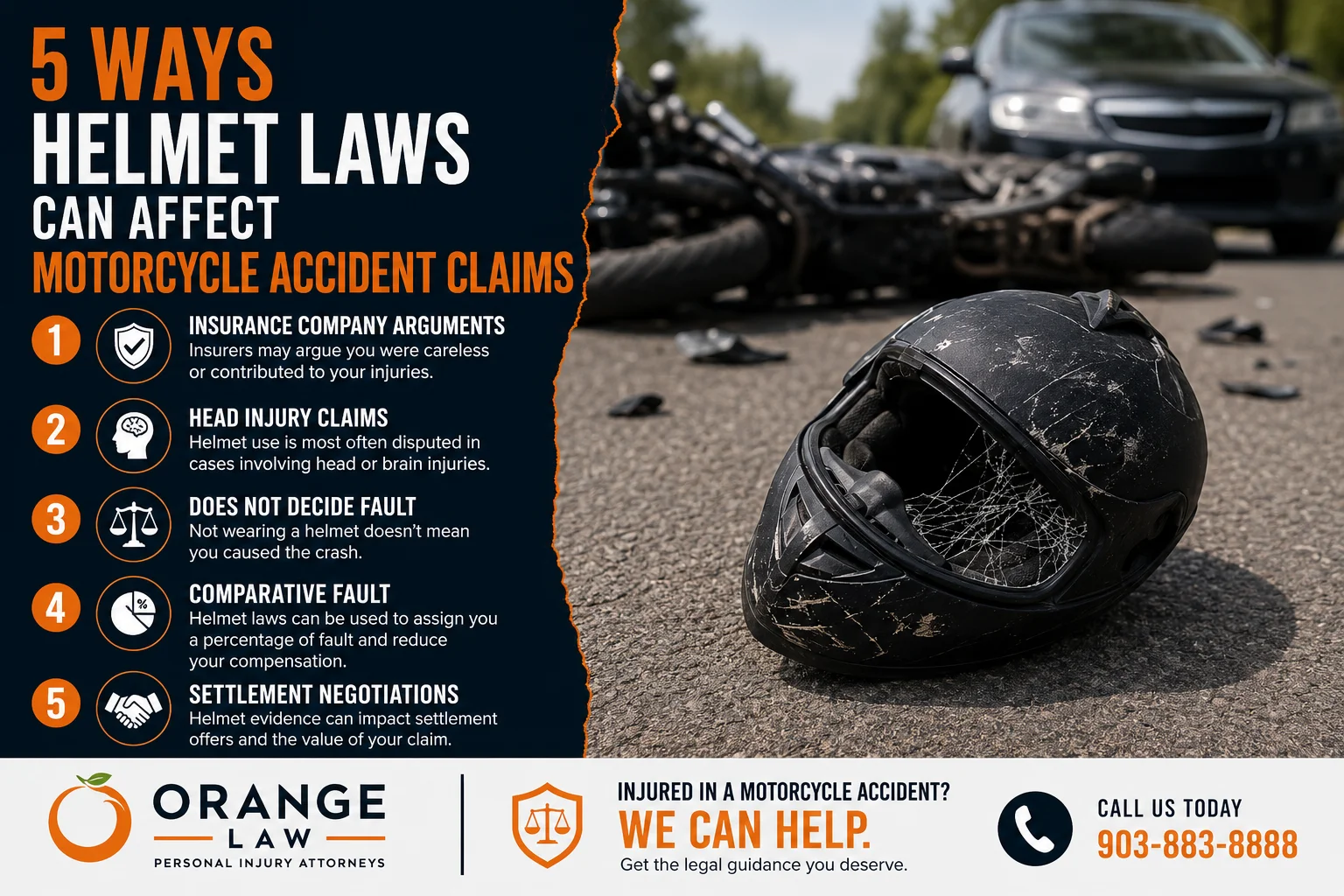
1. Helmet Laws Can Affect Insurance Company Arguments
The first way helmet laws can affect motorcycle accident claims is by giving the insurance company an argument. Insurance adjusters look for facts they can use to reduce liability or damages. If the rider was not wearing a helmet, the insurer may frame the rider as careless, reckless, or responsible for their own injuries.
This is often part of a broader strategy. Insurance companies know that some people have bias against motorcyclists. They may believe riders are more likely to speed, take risks, or ignore safety. Even if those assumptions are not supported by the facts, the insurer may try to use them during negotiations.
For example, suppose a driver makes an unsafe left turn and hits a motorcycle. The rider suffers a traumatic brain injury and a broken arm. If the rider was not wearing a helmet, the insurance company may argue that the brain injury was partly the rider’s fault. The insurer may also try to use that argument to make the entire claim seem weaker, even though the broken arm and the crash itself may have nothing to do with helmet use.
This is why injured riders need evidence. The claim should be based on what actually happened, not stereotypes. Photos, video footage, witness statements, police reports, crash reconstruction, medical records, and expert opinions can help show the driver’s fault and the true cause of the injuries.
An insurance company argument is not the same as proof. Just because an adjuster says helmet use affects the claim does not mean the adjuster is legally or medically correct. The insurer must connect its argument to the facts and injuries.
2. Helmet Use May Affect Head Injury and Brain Injury Claims
Helmet use is most likely to become an issue when the rider suffered a head injury, traumatic brain injury, skull fracture, facial injury, or other upper-body trauma. In those cases, the insurance company may argue that the injury would have been prevented or reduced if the rider had worn a helmet.
This does not automatically defeat the claim. A helmet does not prevent every head injury. A serious crash can still cause a concussion, brain bleed, neck injury, or spinal injury even when a rider wore protective headgear. The type of helmet, impact angle, crash speed, vehicle size, and force of impact may all matter.
Medical evidence is critical in this kind of dispute. The insurance company may make broad statements about helmets, but a real claim should focus on the specific injuries. Did the rider’s head strike the pavement or another vehicle? Where was the impact? What did the imaging show? What did the treating doctors diagnose? Would a helmet have changed the injury? If so, how much? These questions may require expert medical analysis.
It is also important to remember that many motorcycle accident injuries are unrelated to helmet use. A rider may suffer broken legs, internal injuries, road rash, shoulder damage, spinal injuries, or hand fractures. A helmet would not prevent those injuries. If the insurance company tries to use helmet arguments to reduce compensation for unrelated injuries, that should be challenged.
For riders who did wear helmets, the helmet itself may become important evidence. A damaged helmet can show the force and direction of impact. It may also support the seriousness of the crash. Riders should preserve the helmet, visor, jacket, gloves, pants, boots, and any damaged gear after an accident.
3. Helmet Laws Do Not Automatically Decide Fault
A rider’s helmet use does not automatically decide who is at fault for a motorcycle crash. Fault depends on the conduct that caused the accident. Did someone violate traffic rules? Did a driver fail to yield? Did a motorist follow too closely? Was a driver distracted? Did a vehicle make an unsafe turn? Did road conditions or a third party contribute?
The fact that a rider was not wearing a helmet does not tell us whether the driver checked their mirrors, obeyed the speed limit, stopped at a red light, or made a safe turn. Those are separate issues.
This matters because insurance companies may try to use helmet arguments as a shortcut. Instead of focusing on the driver’s conduct, the adjuster may focus on the rider. That can shift the conversation away from liability and toward blame. Injured riders should not allow the insurance company to rewrite the accident.
For example, if a car rear-ends a motorcycle at a stoplight, the driver may be responsible for failing to stop in time. Whether the rider was wearing a helmet does not explain why the car hit the motorcycle from behind. If the rider suffered a leg fracture, road rash, and back injuries, helmet use may have little or no relevance to those damages.
Similarly, if a driver turns left across the rider’s path, the central issue may be whether the driver failed to yield. The insurance company may still claim the rider was speeding or should have been more visible, but those claims must be supported by evidence.
The legal and factual analysis should begin with the crash itself. Helmet use may be one issue, but it should not replace a full investigation into fault.
4. Comparative Fault Can Reduce Compensation
Helmet law arguments often connect to comparative fault or proportionate responsibility. In Texas, a claimant may not recover damages if their percentage of responsibility is greater than 50 percent. If the claimant is 50 percent or less responsible, any recovery may be reduced by the claimant’s percentage of fault.
This system matters in motorcycle accident claims because insurance companies may try to assign a percentage of blame to the rider. They may argue the rider was speeding, failed to keep a proper lookout, rode too close to traffic, failed to avoid the crash, or worsened their injuries by not wearing a helmet.
For example, if a rider’s damages are valued at $100,000 and the rider is found 20 percent responsible, the recovery may be reduced to $80,000. If the rider is found more than 50 percent responsible, recovery may be barred under Texas proportionate responsibility law.
That is why fault percentages are important. Even a small shift in responsibility can affect settlement value. An insurance company may assign an unfair percentage of blame during negotiations. That does not mean the percentage is correct. Fault should be based on evidence, not assumptions.
Helmet use should also be tied to the actual injury. If the helmet issue has no connection to the claimed damages, it should not be used to reduce compensation. If the rider suffered a head injury, the insurer may argue that helmet use matters. If the rider suffered injuries unrelated to the head, the argument may be much weaker.
5. Helmet Evidence Can Affect Settlement Negotiations
Helmet evidence can affect settlement negotiations in several ways. If the rider wore a helmet, that fact may help show that they took safety seriously. If the helmet was damaged, it may help demonstrate the severity of the impact. Photos of the helmet, cracks, scratches, broken visor, and impact marks can support the injury claim.
If the rider was not wearing a helmet, the insurance company may try to use that fact as leverage. The adjuster may offer less money, arguing that a jury may blame the rider. Whether that argument is fair depends on the facts, the law, and the injuries.
Settlement negotiations are not only about what happened. They are also about risk. Insurance companies evaluate how a judge or jury may see the case. If the insurer believes helmet use may create doubt, it may use that risk to lower the offer. A strong legal response can reduce that leverage by showing why helmet use does not control the outcome.
For example, if the rider’s injuries include a broken leg, torn rotator cuff, road rash, and lost wages, the attorney can argue that helmet use has no meaningful relationship to those damages. If the rider did suffer a brain injury, medical experts may be needed to evaluate the degree to which helmet use would or would not have changed the outcome.
The key is not to let the insurance company control the narrative. A settlement should reflect the full facts: who caused the crash, what injuries occurred, what treatment is needed, how the victim’s life changed, and what damages are supported by evidence.
Texas Motorcycle Helmet Law: What Riders Should Know
Texas helmet law is not a universal “everyone must wear a helmet at all times” rule. Under Texas Transportation Code Section 661.003, motorcycle operators and passengers are generally required to wear protective headgear, but the statute includes an exception for certain riders who are at least 21 years old and have completed a motorcycle operator training and safety course or have qualifying health insurance coverage for motorcycle collision injuries.
This matters because an insurance company may suggest that a rider violated the law simply because they were not wearing a helmet. That may not be accurate. The rider’s age, training, and insurance status may need to be reviewed.
Even when a helmet was legally required, that does not automatically decide the entire personal injury claim. The insurer still must connect the alleged violation to the crash or injuries. A legal violation may be relevant, but it does not always erase the other driver’s responsibility.
Because helmet law can be fact-specific, injured riders should avoid making assumptions. They should not admit fault or agree with an adjuster’s legal interpretation without speaking with an attorney.
What If the Rider Was Legally Allowed to Ride Without a Helmet?
If a rider was legally allowed to ride without a helmet, the insurance company may have a harder time using helmet nonuse as a negligence argument. However, the insurer may still try to argue injury causation. In other words, the adjuster may say, “Even if it was legal, the rider made the injuries worse.”
That argument still requires evidence. The insurance company should not be allowed to reduce compensation based only on speculation. It must show that a helmet would likely have changed the specific injuries being claimed.
This is especially important when the injuries are not head injuries. If the rider suffered a broken leg, spinal injury, internal injury, or shoulder injury, the lack of a helmet may not be relevant. If the rider suffered a head injury, medical analysis may be needed.
Legal does not always mean irrelevant, and illegal does not always mean case-ending. Helmet use is one factor in the claim, not the entire claim.
What If the Rider Was Required to Wear a Helmet But Was Not Wearing One?
If a rider was legally required to wear a helmet but was not wearing one, the insurance company may use that fact more aggressively. The insurer may argue that the rider violated a safety law and that the violation contributed to the injuries.
Even then, the case is not automatically lost. The central questions remain: who caused the crash, what injuries occurred, and whether helmet nonuse actually caused or worsened those injuries. A missing helmet may be relevant to a traumatic brain injury claim, but it may not be relevant to a leg fracture, burns, or lower-body injuries.
A careful claim strategy may separate the damages. The attorney may argue that even if helmet use is disputed for one category of injury, the rider is still entitled to compensation for other injuries caused by the negligent driver.
The facts matter. So do the medical records, police report, crash dynamics, and expert opinions.
Helmet Use and Motorcycle Bias
Helmet disputes often overlap with bias against motorcyclists. Some insurance adjusters may already assume riders are dangerous or reckless. If the rider was not wearing a helmet, the insurer may use that fact to reinforce the stereotype.
This bias can be unfair and misleading. Many careful, responsible riders are injured because drivers fail to see motorcycles or fail to obey traffic laws. A motorcycle rider should not be treated as less worthy of compensation simply because motorcycles are perceived as risky.
Bias may show up in police reports, witness statements, insurance notes, and settlement negotiations. A driver may say, “The motorcycle came out of nowhere,” when the truth is that the driver failed to look carefully. An adjuster may say, “Motorcycles are dangerous,” when the real question is whether the insured driver caused the crash.
A strong motorcycle accident claim should push back against bias with evidence. The focus should be on facts: the point of impact, vehicle positions, traffic signals, speed evidence, witness statements, road conditions, and medical documentation.
Common Motorcycle Accident Scenarios Where Helmet Arguments Arise
Helmet arguments can arise in many types of motorcycle crashes. In left-turn accidents, a driver may turn across the rider’s path and then claim the motorcycle was speeding. If the rider was not wearing a helmet and suffered a head injury, the insurer may argue both speed and helmet nonuse.
In rear-end crashes, a driver may claim the rider stopped suddenly. If the rider was thrown from the motorcycle, helmet use may become an issue if there was a head impact. However, the driver still had a duty to maintain a safe following distance.
In lane-change accidents, the driver may say they did not see the motorcycle. That does not automatically excuse the driver. Drivers must check blind spots before changing lanes. Helmet use does not explain an unsafe lane change.
In intersection accidents, traffic signals, witness testimony, and video footage may be critical. The insurer may still focus on the rider’s gear, but the main issue may be who had the right of way.
In each scenario, helmet use should be evaluated in context. It should not be used to distract from the driver’s negligence.
What Evidence Helps Protect a Motorcycle Accident Claim?
Important evidence in a motorcycle accident claim may include photos of the scene, photos of vehicle damage, motorcycle damage, helmet damage, road conditions, traffic signs, skid marks, debris, and visible injuries. Video footage from dashcams, traffic cameras, nearby businesses, homes, or helmet cameras can be powerful.
Witness statements are also important. Independent witnesses may confirm that the other driver turned improperly, failed to yield, changed lanes unsafely, or was distracted.
Medical records are critical when helmet use is disputed. The records should show the type of injury, diagnosis, treatment, prognosis, and whether future care is needed. If the insurance company claims a helmet would have prevented the injury, medical expert analysis may be necessary.
The helmet itself should be preserved if the rider wore one. Do not throw away damaged gear. The helmet, jacket, gloves, pants, boots, and motorcycle may all help show the severity of impact.
What Injured Riders Should Avoid Saying to Insurance Adjusters
After a motorcycle crash, the insurance company may call quickly. The adjuster may sound friendly and helpful, but their job is to protect the insurance company. Injured riders should be careful.
Avoid saying “I’m fine,” “I didn’t see them,” “I may have been going fast,” “I should have worn a helmet,” or “It was partly my fault.” These statements can be taken out of context.
Do not guess about speed, distance, timing, or medical diagnosis. If you do not know, say you do not know. Do not agree to a recorded statement without legal guidance. Do not sign broad medical authorizations. Do not accept a quick settlement before you know the full extent of your injuries.
A quick settlement may not include future surgery, therapy, lost earning capacity, or long-term pain. Once a settlement is signed, the claim is usually over.
What Compensation May Be Available?
Compensation in motorcycle accident claims may include emergency medical treatment, ambulance bills, hospital care, surgery, physical therapy, medication, specialist care, future medical care, lost wages, loss of earning capacity, pain and suffering, mental anguish, physical impairment, disfigurement, and property damage.
If helmet use is disputed, the available compensation may depend on whether the insurance company can connect helmet nonuse to the specific injuries. The rider may still recover for injuries unrelated to helmet use.
In fatal motorcycle crashes, surviving family members may have wrongful death and survival claims. These claims can include funeral expenses, loss of support, loss of companionship, and other damages allowed by law.
In Texas, many personal injury lawsuits must be filed within two years from the date the cause of action accrues. Some cases may have shorter deadlines or special notice requirements, especially if a government entity is involved. Riders should not wait until the deadline is close because evidence can disappear quickly.
How Orange Law Can Help With Helmet-Related Motorcycle Accident Claims
Orange Law can help injured riders respond to helmet-related insurance arguments. Our team can review the crash facts, gather evidence, analyze fault, preserve helmet and motorcycle evidence, obtain medical records, evaluate damages, and deal with the insurance company.
If the insurer is using helmet nonuse to reduce the claim, we can help determine whether that argument is legally and medically supported. We can also identify injuries that are unrelated to helmet use and should still be fully compensated.
Motorcycle accident claims require strong advocacy because riders often face unfair blame. The goal is to make sure the case is evaluated based on evidence, not bias.
Frequently Asked Questions About Helmet Laws and Motorcycle Accident Claims
Can I still file a motorcycle accident claim if I was not wearing a helmet?
Yes. Not wearing a helmet does not automatically prevent you from filing a claim. The result depends on the crash facts, state law, injuries, and whether helmet use is legally or medically relevant.
Does Texas require motorcycle riders to wear helmets?
Texas generally requires motorcycle operators and passengers to wear protective headgear, but there are exceptions for certain riders who are at least 21 years old and meet training or health insurance requirements.
Can the insurance company reduce my settlement because I was not wearing a helmet?
The insurance company may try. Whether that argument is valid depends on whether helmet nonuse actually caused or worsened the injuries being claimed.
Does helmet use matter if I suffered a broken leg or back injury?
Helmet use is usually less relevant to injuries unrelated to the head or face. A helmet does not prevent every type of motorcycle injury.
What if I suffered a brain injury?
If you suffered a brain injury, helmet use may become a major issue. Medical evidence and expert analysis may be needed to determine whether a helmet would have changed the injury.
Can a helmet dispute make me responsible for the crash?
Not automatically. Helmet use is different from crash causation. Another driver may still be responsible for causing the accident.
What if I was legally allowed to ride without a helmet?
If you were legally allowed to ride without a helmet, the insurance company may have a weaker legal argument, but it may still try to argue that helmet use would have reduced the injury.
Should I keep my damaged helmet?
Yes. A damaged helmet can be important evidence of impact force and crash severity.
Should I give a recorded statement to the insurance company?
You should be careful. Insurance adjusters may ask questions designed to shift blame or reduce compensation. Speak with an attorney before giving a recorded statement.
How long do I have to file a motorcycle accident lawsuit?
In Texas, many personal injury claims generally have a two-year deadline, but exceptions and shorter notice requirements can apply.
Final Takeaway
Helmet laws can affect motorcycle accident claims, but they do not automatically decide the case. The most important questions are who caused the crash, what injuries occurred, whether helmet use was legally required, and whether the lack of a helmet actually caused or worsened the injuries being claimed.
Insurance companies may use helmet arguments to reduce compensation, especially in head injury cases. Injured riders should not accept those arguments without evidence. A motorcycle accident claim should be based on facts, medical records, crash evidence, and the full impact of the injuries.
If you were injured in a motorcycle accident, protect your health, preserve your evidence, avoid quick settlement offers, and speak with an attorney before dealing with the insurance company.
Call Orange Law After a Motorcycle Accident
If you were injured in a motorcycle crash and the insurance company is using helmet laws against you, Orange Law can help.
Our team can investigate the accident, challenge unfair blame, evaluate helmet-related arguments, deal with the insurance company, and pursue the compensation you deserve.
Contact Orange Law today to speak with a personal injury attorney about your motorcycle accident claim.